
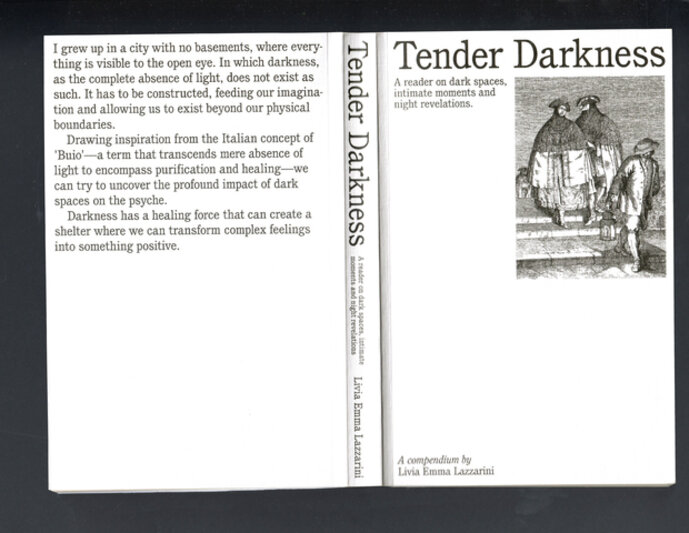
Tender Darkness. Cover spread, 200pp. (© Livia Emma Lazzarini)
In contemporary museum spaces, the prevalence of brightly lit spaces – the so-called “white-boxes” – can be jarring when juxtaposed with artworks representing scenes of violence and discrimination. While it is essential to process historical events and give visibility to minority groups, in these contexts, the contrast between the bright environment, the subject matter and reality itself can create a disconnect.
This dissertation explores the tension between brightly lit museum spaces and their representation of challenging political subjects, proposing dark environments as a counter-narrative. Basements, bunkers and darkrooms, in this sense, can be redemption spaces that leave room for redefining power structures, for freedom and emotions.
A dark space is thus a fundamental way of facilitating transformative experiences, where the gaze is negated and we all feel vulnerable, inviting considerations of how limited visibility might paradoxically enhance our ability to "see" in a broader, more emotionally and intentional engaged sense – raising the question: can darkness foster emotional proximity and encourage new ways of seeing?