
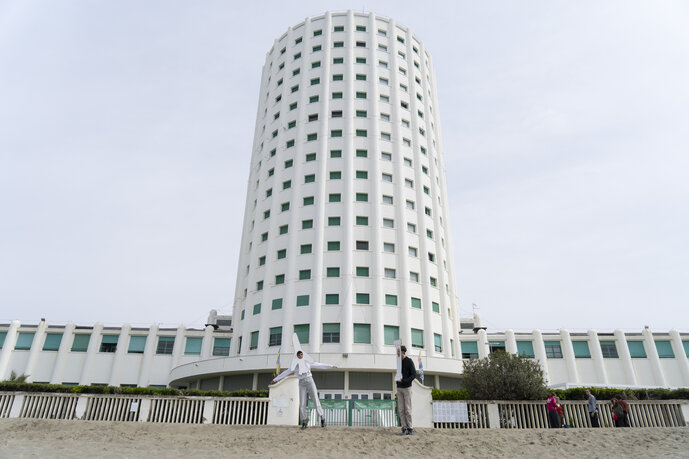
Performers in front of the Torre Fiat (© Laura Maureen Weser)
On the beach of Marina di Massa, in northern Tuscany, a white tower rises into the sky. A relic from Fascist Italy - it is the only fully preserved building of a number of so called holiday colonies built in the 1920s and -30s along the coast of Massa. The white tower was commissioned by car manufacturer Fiat and, from 1933 onwards, served as a summer camp for the children of its workers. It was designed and executed by Vittorio Bonadè Bottino, an engineer from Turin. Today it is part of a commercial holiday resort.
In its historical use as well as its design, the tower is interwoven with the propaganda complex of the fascist regime: it is ideology cast in architecture. As such, the tower inescapably seems to stand for a linear, violent historiography. Following from Marco Giorgio Bevilacqua's "The Helixes of Vittorio Bonadè Bottino: Symbolism, Geometry and Architectural Types” (2015), TOWER POWER embarks on a performative investigation of the formal language and symbolic burden of the tower:
"Are we in an airplane? A column? A ‚fascio littorio‘? What would each scenario mean? […] It’s just a building, right?"
With the help of Ursula K. Le Guin’s „Carrier Bag Theory of Fiction“ (1986), TOWER POWER questions the narratives inscribed on the tower and how such a charged architectural legacy is dealt with.
TOWER POWER was developed as part of the "Performing Landscapes of Leisure and Extraction: Quarries and other Colonies" seminar run by Céline Condorelli and Hanne König. Students spent one semester researching both the Torre Fiat and the nearby marble quarries of Carrara. The works developed were exhibited as part of the public programme of POST-COLONIA Festival for Architecture and Imaginaries in Transition, which took place for the first time in and around the tower as exhibition venue.