
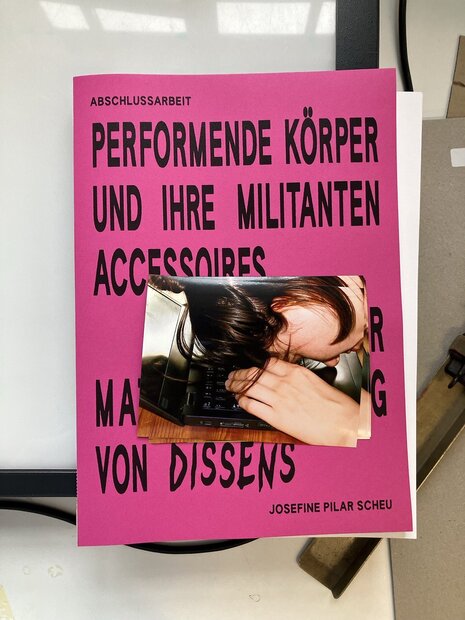
Titelblatt (© Josefine Scheu)
Based on the assumption that protest is articulated not only through language or bodies, but above all through objects, the master's thesis focuses on the material-symbolic politics of feminist protest performances. To this end, the concept of the “militant accessory” is proposed as an analytical category for feminist performance practices. The accessory, often associated with bodies read as female*, is reinterpreted and recontextualized from a seemingly harmless fashion element to an action-oriented, resistant object.
Based on the activist-performative actions of the Women's Social and Political Union (Window Smashing Campaign, 1912) and Pussy Riot (Punk Prayer, 2012), two objects - a 19 cm toffee hammer and a neon-colored balaclava - are identified as “militant accessories”. In their relationship to the bodies, these accessories enable political and emancipatory potentials to unfold and transform places into spaces of protest.
This analysis is transferred to artistic protest performances in the final chapter. Artistic productions by Selma Selman (You Have No Idea), Pipilotti Rist (Ever Is Over All) and Milica Tomić (One Day, Instead of One Night, a Burst of Machine-Gun Fire Will Flash, if Light Cannot Come Otherwise) are considered. The extent to which “militant accessories” offer a way of expressing protest not only in collective protest performances, but also for individual bodies in feminist artistic performances, is examined.
The work illuminates the complex relationship between art and protest and shows that “militant accessories” are not only symbolic carriers of meaning, but also act as a means of resistance in their relational and physical-performative dimension. In interaction with the acting bodies, they function as catalysts and mediators who unfold a double role as material-semiotic actors.