
The Hermann Levi Square, the forecourt of the Badisches Staatstheater Karlsruhe, will remain a transitional space between several major construction sites until approximately 2036.
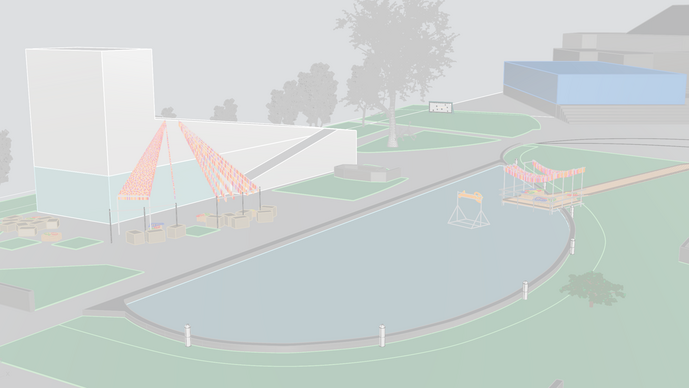
Against this backdrop, the temporary spatial intervention Paradise enters into a dialogue with the urban wasteland. By symbolically renaming the square "Paradise," the project explores the potential of this site as a vibrant ecological and social space that invites reflection on nature, sustainability, and community. The intervention consists of three interconnected places for gathering, learning, and exchange:
A) Biotopos – Paradise as a Place of Learning
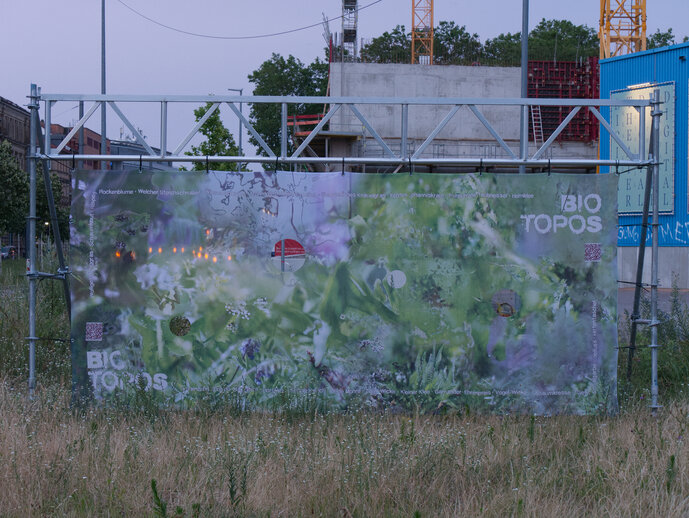
The installation highlights an unnoticed biotope that has emerged at the edge of the square. Drawing on Gilles Clément's concept of the "Third Landscape," this wild space contrasts with the ordered principles of urban landscape architecture. A large-scale banner composed of approximately 200 seamlessly merged photographs of the site's vegetation serves as a bridge between reality and imagination. Integrated viewing holes encourage visitors to observe the biotope directly, while a QR code links to a botanical archive, extending the installation into a digital learning environment.
B) A Footbridge Leading to an Island – Paradise as a Place to Stay
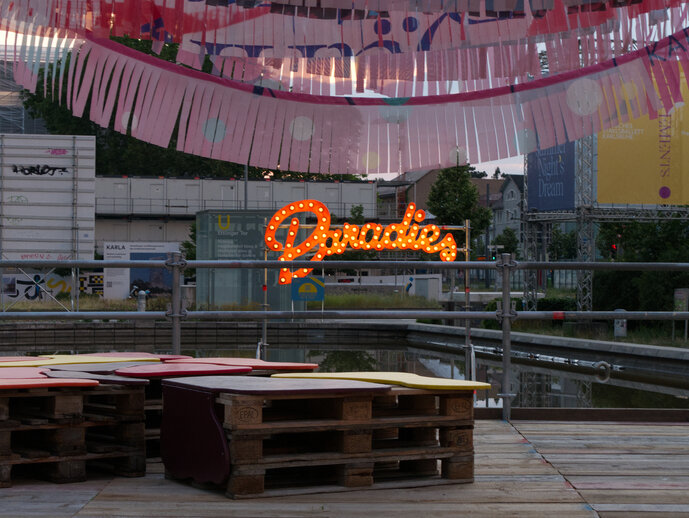
Amid concrete and construction noise, an accessible footbridge leads to a platform at the water basin on the square. Seating elements and shade-giving pennants invite visitors to linger. The bridge explores the idea of paradise as a place of longing—one that can be approached but never fully reached. The illuminated orange "Paradise" sign completes the image of a visible yet unattainable island paradise, existing simultaneously as a physical object and an abstract idea.
C) Planting Area and Plant Exchange at the K-Point – Paradise as a Social Space
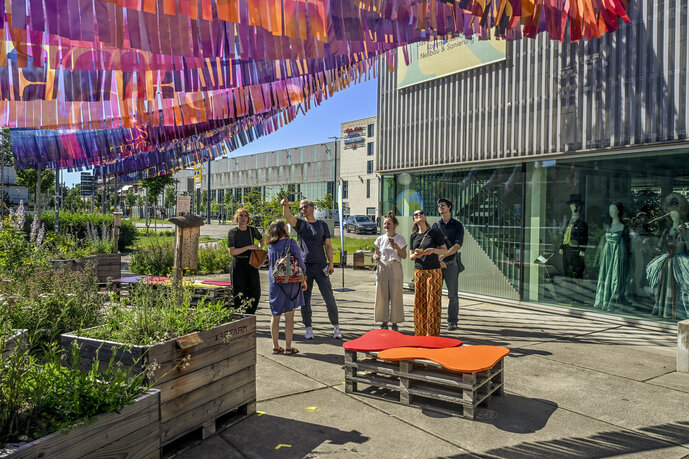
Planted Refarm containers, colorful seating elements, and shade pennants complement the existing unsealed concrete surfaces, transforming the square into a place of social interaction and exchange. At its center is a plant exchange, which not only encourages visitors to swap plants but also to care collectively for herb beds, presenting paradise as a shared and ongoing process. Like an exhibition space, the seating areas invite visitors to observe and engage with the plants.
The scenographic intervention was preceded by extensive research, including spatial analyses of the square and its vegetation, a visit to the theater construction site, research into the site's architectural history, and an examination of the city's future development plans. Sustainability guided the entire production process. Materials such as the pennants, as well as pallets and seating elements, were reused and repurposed wherever possible.
Concept and realization of the spatial intervention Paradise by students from all study programs at Karlsruhe University of Arts and Design (HfG Karlsruhe):
Doi Yan Chan, Tobias Ehrhardt, Wera Hertenstein, Lorena Karn, Carl Koch, Florian Lips, Chae Young Moon, Rebekka Scheib, Noah Seider, Joscha Thorn, Lola Vorläufer, Linhui Yang
Graphic Design: Maïmouna Diop, Benedikt Endres
Illuminated Sign: Marlon Schuch
Seminar Director: Prof. Constanze Fischbeck
Dramaturgy and Production: Anna Haas and Marlies Kink
Artistic Collaboration: Eva-Maria Lopez
The project was made possible through funding from the ZERO programme of the German Federal Cultural Foundation (Kulturstiftung des Bundes) and HfG Karlsruhe, in close cooperation with the Badisches Staatstheater Karlsruhe.