
© Philipp Kern
© Philipp Kern
© Philipp Kern
© Philipp Kern
© Philipp Kern
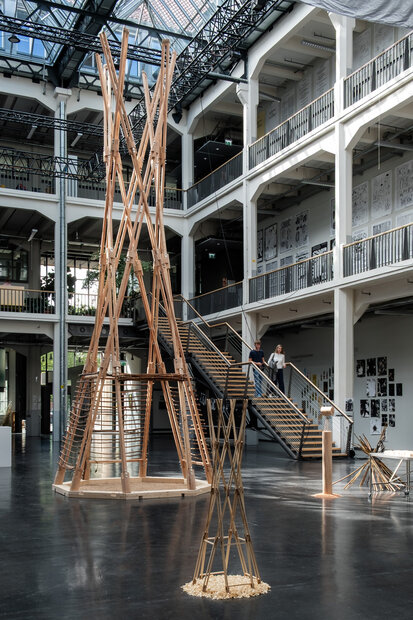
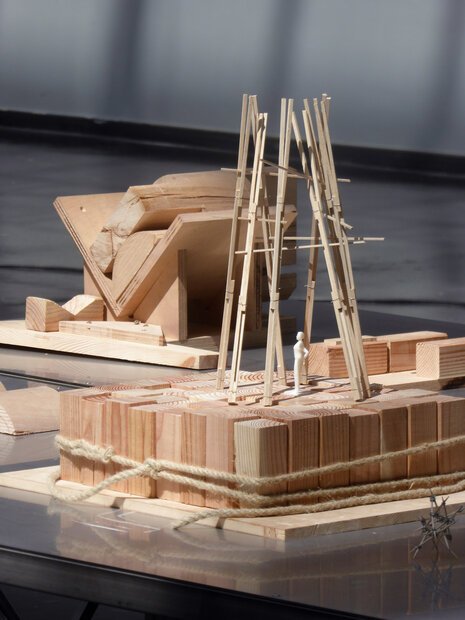
The Nest is a creative exploration and spatial interpretation of knowledge about bioregionalism and our surrounding ecosystem. In workshops on the topics of the timber industry, invasive plant species, and hemp production—led by regional and international experts—various raw materials were explored through material experiments and artistically transformed. From these collaborative experiments emerged the idea of the Nest: a symbol of habitat, protection, and communal togetherness.
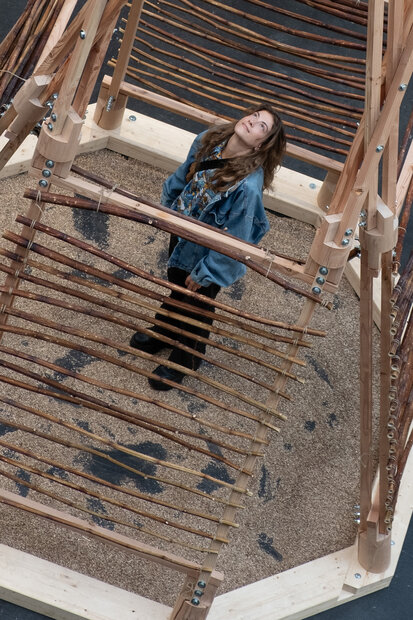
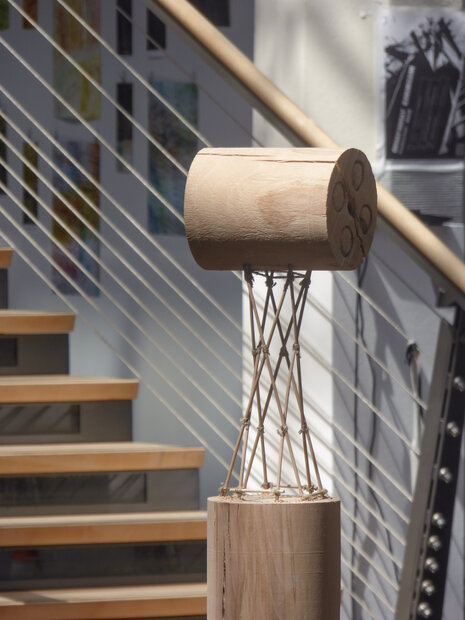
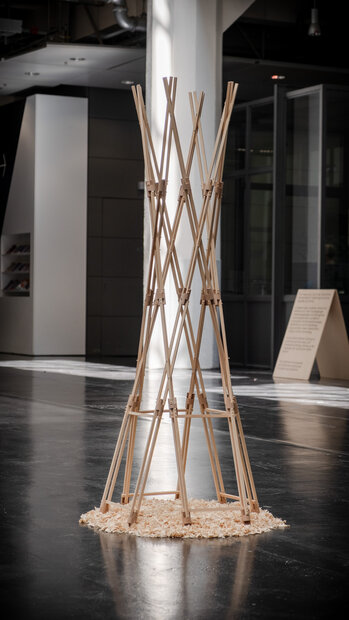
The Nest’s vertical structure, which rises eight meters high, is inspired by the branching patterns of nature. At the same time, it combines various materials and their properties: wood species such as beech, spruce, and Douglas fir; Japanese knotweed—an invasive plant; and hemp. The nodes consist of beech cores, a byproduct of veneer production in the northern Black Forest. They enable the twisting and mutual stabilization of the hyperbolic form. The beech, as a native tree and habitat for over 200 animal species, symbolically and structurally holds the system together.
The ring on the ground—the “rooting”—is covered with leftover materials from the construction process. They form a forest floor that connects people and materials—a place to linger, feel, and marvel, with an open view upward.
Concept and Realization
Philipp Kern, Ellen Su, Julius Bleher
Under the direction of
Freia Achenbach, Simon Gehring, Julia Ihls