
Ege Bayraktar & Benedikt Endres
The Deadly Speech Tonight investigates the power of speech through the example of the multiple Emmy Award–winning satirical news program Last Week Tonight with John Oliver.
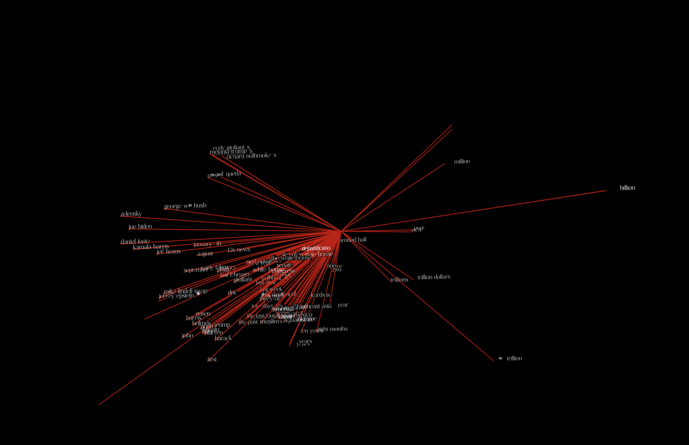
Using natural language processing and machine learning, the project analyzes scripts from the show's extensive archive. Named entity recognition, vector embeddings, and dimensionality reduction algorithms uncover hidden relationships between people, organizations, corporations, countries, events, and recurring topics.
Rather than presenting language as a linear narrative, the installation reveals it as a complex network of associations. Entities that frequently appear together form semantic clusters, exposing patterns of discourse that often remain invisible within individual episodes. The final installation presents an interactive environment of dynamic word-cloud clusters, organized into thirteen thematic categories recurring throughout Oliver's work. Visitors can navigate these semantic landscapes, discovering relationships between entities and exploring how language constructs narratives around contemporary issues.
By translating large-scale textual analysis into an immersive visual experience, the work reflects on the so-called "John Oliver Effect"—the capacity of media narratives to shape public awareness and political discourse—positioning speech not merely as communication, but as an active force capable of shaping perceptions, institutions, and social realities.
Ege Bayraktar
Ege Bayraktar studies Media Arts at Karlsruhe University of Arts and Design (HfG Karlsruhe). Prior to this, he studied Molecular Biotechnology at Heidelberg University from 2017 to 2022, graduating with a Bachelor's degree, and subsequently pursued a Master's degree in Bioinformatics at Goethe University Frankfurt.
His artistic practice is situated at the intersection of computational methods, artificial intelligence, and generative art. Working with machine learning models, creative coding environments such as p5.js, and large-scale datasets, he develops audiovisual systems that explore emergence, complexity, and the relationship between human perception and algorithmic processes. His current studies focus on the artistic potential of data-driven systems and contemporary digital media.
Benedikt Endres
Benedikt Endres studies Media Arts at Karlsruhe University of Arts and Design (HfG Karlsruhe). Before beginning his studies, he spent two years at the Badisches Staatstheater Karlsruhe, working in communications and marketing as well as serving as a production and rehearsal assistant for various theatrical productions.
His artistic practice encompasses staged photography, media scenography, and the digital transformation of theatrical spaces. He is particularly interested in the relationship between performing arts and emerging technologies, exploring how digital and analog formats intersect, influence one another, and create new possibilities for audience engagement. His work investigates the role of media within performative contexts and the evolving nature of contemporary cultural production.