
© Erik Grunder
© Erik Grunder
© Erik Grunder
An Applied Materials Study on 2.5mm Rotationally Cut Veneer
Rotationally cut veneer is one of the few methods of wood harvesting that follows the natural, round shape of the tree. A trunk that has been previously delimbing and steamed rotates horizontally against a long blade, similar to a pencil sharpener. This process produces a continuous strip of wood. Since no traditional sawing mechanism is used, very little dust is produced and there is virtually no material loss from saw cuts. The rotational process applied to the round log makes material yield particularly efficient. Compared to sawing a log at a sawmill—where a round log is cut into square solid wood pieces—the yield is about 30–40% higher.
Veneer is mostly used for decorative purposes to enhance surfaces. It plays a key role, above all, in cross-laminated composite materials, where it develops surprising stability and design flexibility when combined with other materials. Through minor adjustments to the production process, the veneer can be harvested not only as individual sheets but also as a continuous roll with defined dimensions. This roll serves as the starting point and raw material for a small-batch furniture series.
The “2.5” series explores the structural possibilities of this material through a reinterpretation of classic processing methods.
© Erik Grunder
2.5.H1
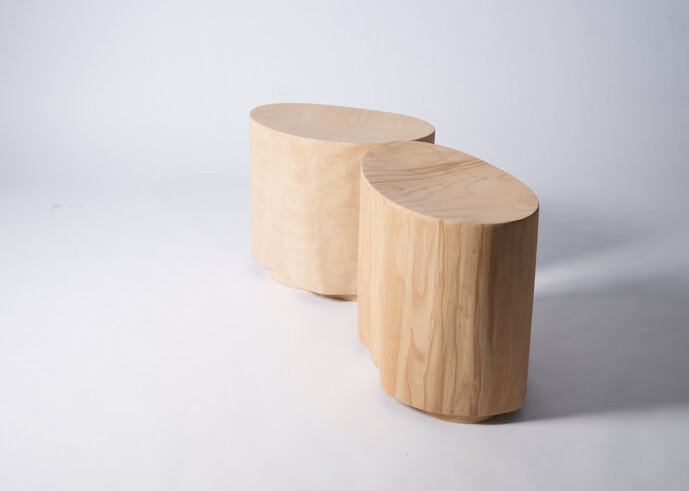
A stool with a double-curved seat shell made of molded veneer. An extruded edge banding continues spirally along the inside, forming a load-bearing structure. The shadow gap between the seat shell and the floor, created by the seat shell’s geometry, simultaneously reveals the textural appearance of the natural warps that form in the veneer during the drying process.
2.5.R1
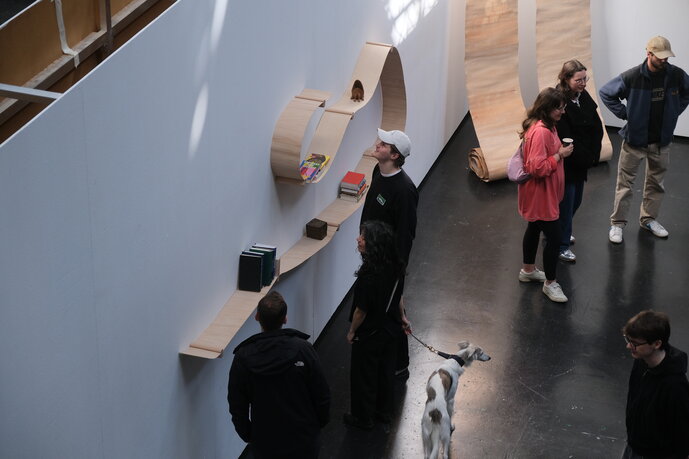
A wall shelving system that utilizes the continuity of the veneer roll, made possible by removing it early in the production process. A thin barrier layer stabilizes the fiber structure and absorbs tensile forces, which it transfers to the freely positionable clamp brackets. This maintains minimal material thickness while ensuring maximum flexibility. Freely positionable shelf brackets allow for playful design freedom and create a lightweight yet sturdy shelving system with minimal material usage.
2.5.R2
A wall shelf that utilizes the cross-grain of the veneer along the short side. What initially appears to be a weakness actually enables high stability with very little material thickness, thanks to the reinforcement of the edges. The shelf is secured exclusively along the wall-facing side. Natural warping in the material creates a dynamic interplay between the veneer layers and results in an expressive front face.
2.5.S1
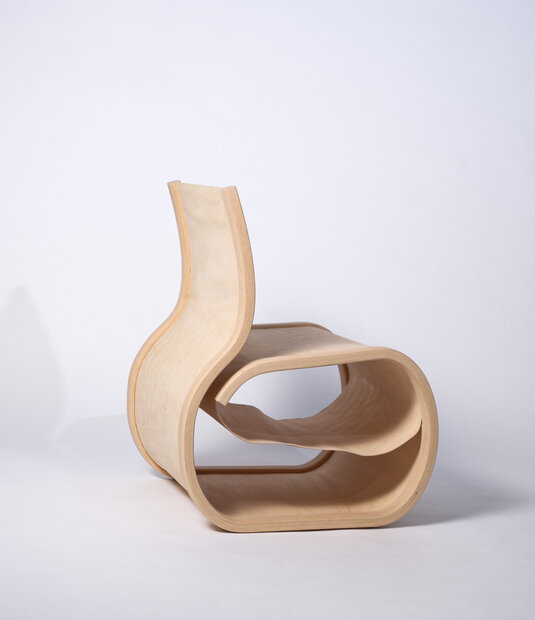
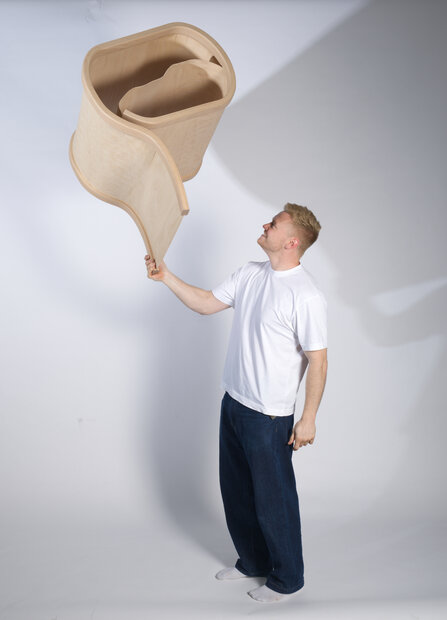
The armchair combines shaped lamination with the principles of coffered construction. Cross-grained veneer transfers forces directly to two load-bearing longitudinal strips. In areas subject to particularly high stress, the material is doubled without necessarily being glued together. Curves beneath the seat reveal the structure. Rigid joints are created only where necessary, allowing the material’s flexibility to be fully utilized and providing comfort as well as natural cushioning.