
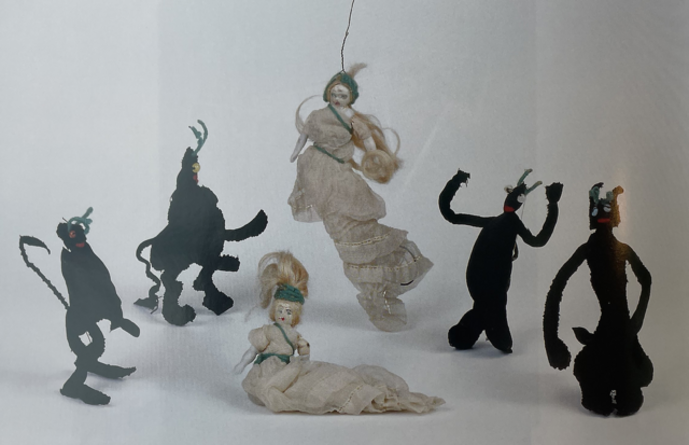
Julia Feininger „Teufelchen und Feenmädchen“
What is camp and how does one define its aesthetics? Can camp be defined at all?
Camp describes a way of perceiving cultural phenomena – whether films, fashion, or design objects – that consciously embraces what is artificial, exaggerated, and theatrical, rather than treating it as a flaw. This sensibility for campiness is mostly acquired by queer people and is therefore not a familiar concept for many. In the seminar „Amongst Ghosts: Queering Bauhaus," Michael Köder searched for queer perspectives and stories within the Bauhaus school. Looking at the Bauhaus through a campy lens, he stumbled upon treasures – both well-known and lesser-known Bauhaus projects that are practically screaming camp. In a reading performance incorporating karaoke elements, Köder draws on Bauhaus projects to awaken a sensibility for campiness in everyone.
Michael Köder is a communication design student with a focus on playful, tactile and multimedia approaches to socials subjects. Projects are often realized through objects, 3D-animations or a combination of both. As graphic designer he plays with sensorial experiences through choices of paper, printing- and binding techniques. Each work is carefully crafted to not just transmit information through reading but multiple senses. The topics of his works often gravitate around social matters – from things as simple as playing together to more sensible topics like the shame in bloodstains found in clothing. All of his works rely on some sort of interaction in order to create individual and personal experiences.