
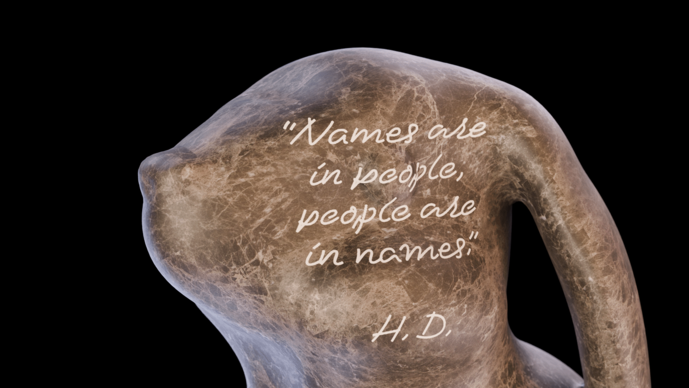
Video still from the essay “by my own authority“
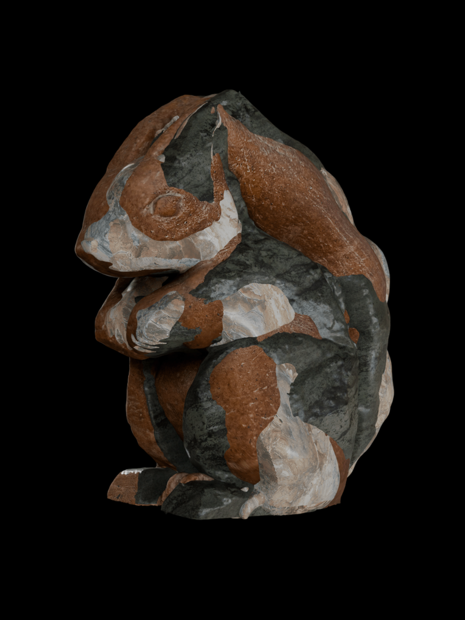
Video still from the essay “by my own authority“
“Since the end of September of this year I have legal authorisation to be allowed to wear men’s clothing, a permission I am now using.” This sentence—the final sentence of Hans Voelcker’s résumé in his application to the Bauhaus in Weimar in 1920—is the starting point for the project “by my own authority” (working title).
At the heart of the work is a video essay that tells the story of Hans’s life based on the sparse archival documents that exist, with a focus on his time as a student at the Bauhaus and its predecessor institution. At the center of the work is a video essay that talks about Hans’s life based on the sparse archival documents that exist, with a focus on his time as a student at the Bauhaus and its predecessor institution. It broadens the perspective on traces of queer life at the Bauhaus by examining the widely used nicknames of students at the time and provides a condensed overview of the evolution of the legal situation for trans people over the past hundred years. Ultimately, everything comes down to the question of legibility as a state control mechanism—that is, what must be visible in order to be administered.
the acoustic layer is juxtaposed with images of digital sculptures. Inspired by a comment from his teacher regarding a sculptural study that oscillates between a squirrel and a rabbit, ambiguous animals—which intersect, overlap, and deform one another—are examined by the virtual camera. Accompanying the video work is an excerpt from the birth register, which also notes Hans’s name change, as well as an object that is both an animal statue and a stamp. In reference to official stamps used by government agencies to certify documents, the stone object invites viewers to appropriate this “weighty” process and leave behind the statement “by my own authority.”
The work is on display in a construction trailer that has been turned into a queer bar for the duration of the Rundgang, alongside other works that bring to light hidden queer stories and interpretations of the Bauhaus.
The project was developed as part of the one-year seminar “Amongst Ghosts: Queerying Bauhaus.” The artistic interpretation was preceded by the essay “Haunting Permitted: A Hauntological Reading of a Trans Student’s Archival Traces at the Bauhaus and the Logic of Permission Across a Century,” which will be published in the Umbau Journal of the HfG.
The essay is based on research into the legal treatment of trans identities in Germany from the Weimar Republic to the present, as well as archival inquiries and research in digitized collections and on site at the Bauhaus in Dessau. Using the concept of hauntology developed by Derrida—which introduces the notion of ghosts as a philosophical tool—the project explores the significance of permission in the lives of trans people in this society and uncovers remnants of outdated assumptions from past decades.