
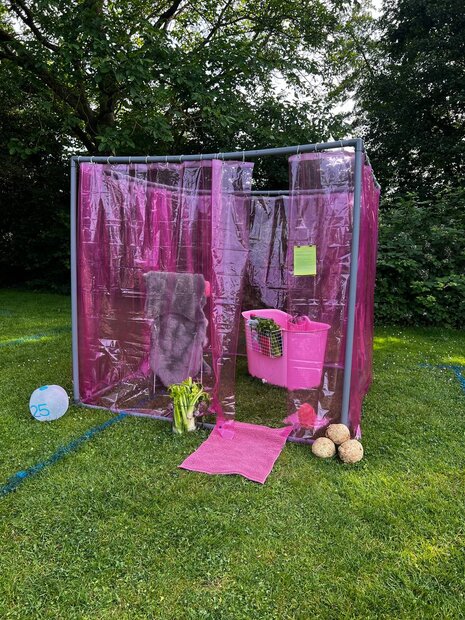
Exhibition view of the work “Clean Girls” at the Rüppur Outdoor Pool as part of the exhibition “Chlor-Filled Days 2026”, Photo: Hannah Bingen, Alexandra Haas, Edona Ibrahim
Clean Girls Go Dirty or how to get really really really really clean
Description of the Work/Project:
Through visual, performative, and bathing-based exploration, we examine the narratives behind the concepts of cleanliness and purity and how the “Clean Girl” trend can be deconstructed in relation to capitalist and neo-fascist body ideals. At the center of our work is a pink bathtub. Behind its curtain, we take you on a journey to find, empower, or get to know your inner Clean Girl all over again. Everyone is welcome in our bathtub, though it can only be experienced alone. You don’t need to bring anything—just let yourself go and be curious. This interactive bath encourages you to engage with body images, routines, and notions of purity so that you can reemerge as a ✨perfect✨ Clean Girl.
The starting point is the social media trend of the “Clean Girl,” which stages seemingly effortless naturalness and self-optimization. The work critically engages with this aesthetic and asks to what extent it also reflects normative, exclusionary, and even neo-fascist (body) ideals. Short biography of the artist(s) or information about the collective or the creation process. For this installation, three artists have come together whose artistic practices combine perspectives from art history and media philosophy with those of exhibition design and scenography.
Lydia Xynogala’s “Body Work” seminar—along with an exploration of the “Clean Girl” social media trend as a body regime and the motif of the bathtub as a symbol of cleanliness and ritual—forms the starting point for our work. Based on research and theory on topics such as purity, healing, body ideals, and their political dimensions, an intuitive, collaborative, and humorous process emerged, which took shape in an interactive installation.
About the Artists:
Alexandra Haas (Art History & Media Philosophy) engages both theoretically and practically with speculative worlds that reflect current social phenomena and developments. In her artistic practice, she frequently combines different media—such as music, text, and textile objects—to create installation-based works.
Hannah Bingen (Exhibition Design & Scenography)’s artistic practice spans performance, installation, and spatial research. She finds forms for sociopolitical discourses, follows material traces and embodied experiences, and works with various media.
Edona Ibrahimi (Art History & Media Philosophy) moves between theory, writing, and collective, political practice. As part of her artistic and research-based work, she engages with political philosophy, politics of representation, and the modes of operation of knowledge and power, discourse, and the canon, while exploring the resistant potential of collective work.
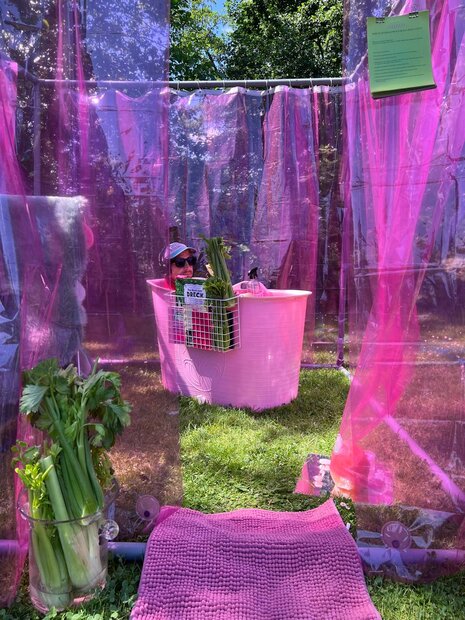
Exhibition View Part 2, Photo: Hannah Bingen, Alexandra Haas, Edona Ibrahim
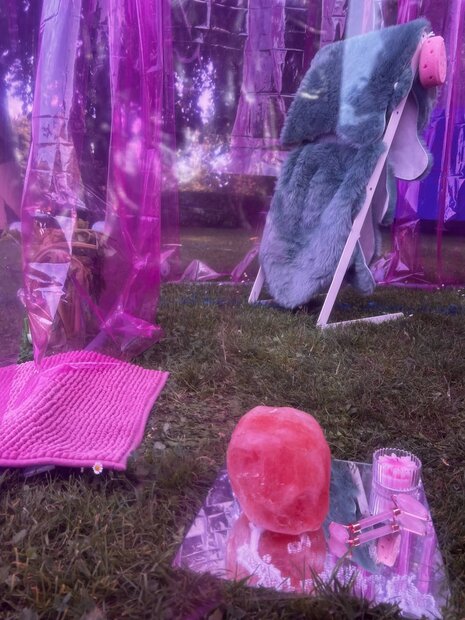
Exhibition View Details, Photo: Hannah Bingen, Alexandra Haas, Edona Ibrahim