
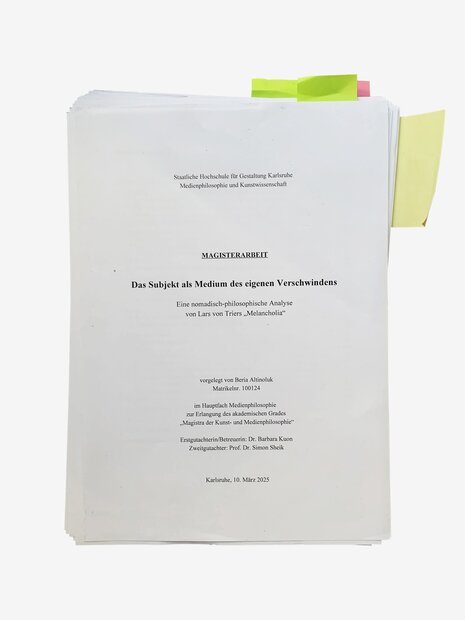
Title page (© Beria Altinoluk)
This master's thesis examines Lars von Trier’s Melancholia as a cinematic space of thought and perception in which subjectivity is constituted under the conditions of a temporal diagnosis described in contemporary German theory as the “absolute Gegenwart” (literally: “absolute present“). The term originates in Absolute Gegenwart (2016), an edited volume by Marcus Quent. This volume describes contemporary structures of experience and temporality as a field of tension between acceleration, stasis, and the erosion of difference, accompanied by a state of impotence in which action and thought are increasingly constrained. This analysis serves as the point of departure for an approach that does not treat the film as an illustration of theoretical models, but instead seeks to engage it on the basis of its own logic of perception.
At the center of the analysis lies melancholy as a mode of perception, not understood as a clinical pathology, but as a transformation of one’s relation to the world, in which the experience of the Other is transformed into a shifted and intensified form of accessibility. The planet Melancholia does not function as a symbolic object, but as a threshold figure of a paradoxical outside that is simultaneously external to the world and internal to the subject. Within this structure, the Other no longer appears as a stable counterpart, but as a movement of withdrawal that affects, destabilizes, and displaces perception. The melancholic intention stands in a paradoxical relation to this outside, characterized by an approach through non-appropriation, or appropriation in the mode of non- possession, within which a virtual field of the sensible and the non-sensible emerges, reorganizing the very space of experience.
The thesis combines psychoanalytic perspectives (Sigmund Freud, Jacques Lacan) and philosophical approaches to melancholy (Giorgio Agamben) with the thought of Gilles Deleuze, which constitutes the central theoretical framework of the study. Particular emphasis is placed on his conception of desire beyond subject and object and on his philosophy of difference. In addition, contemporary diagnoses of the present by Byung-Chul Han and Alain Badiou, as well as further theoretical contributions by authors such as Mark Fisher and Judith Butler, are incorporated.
The analysis of the film follows a structure of prologue and apocalyptic event, within which an experiential and psychological space unfolds between a first and a second downfall. Melancholia is thus read as an experimental arrangement in which the end of the world appears as a precarious threshold, in which perception, desire, and world relation are reconfigured. The thesis argues that subjectivity gains its capacity for openness toward alterity precisely in the projection of its own disappearance.