
© Alejandra Miranda Janus
© Alejandra Miranda Janus
© Alejandra Miranda Janus
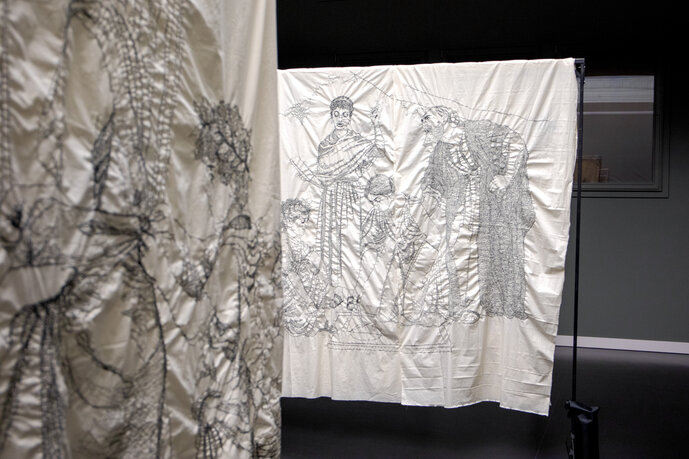
The work was created in the seminar Frameworks of Fiction in collaboration with the Kunsthalle Mannheim. The seminar's starting point was a critical examination of the Kunsthalle Mannheim's collection, particularly its historical paintings and the image constructions they represent. Students were free to choose a work from the collection as the starting point for their own artistic work. Among the works addressed were The Execution of Emperor Maximilian, The Turkish Abduction of Women and Anselm Feuerbach's Hafiz at the Tavern, which forms the starting point of this work.
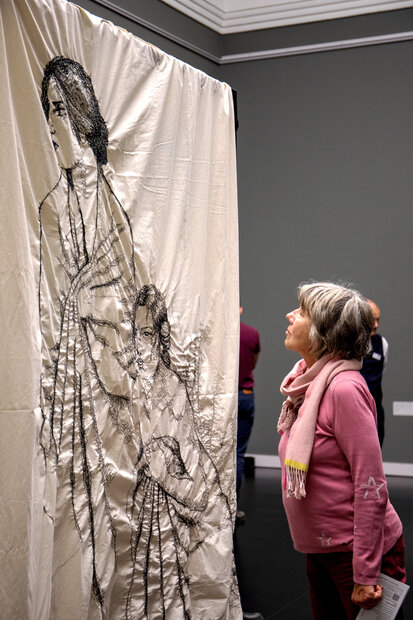
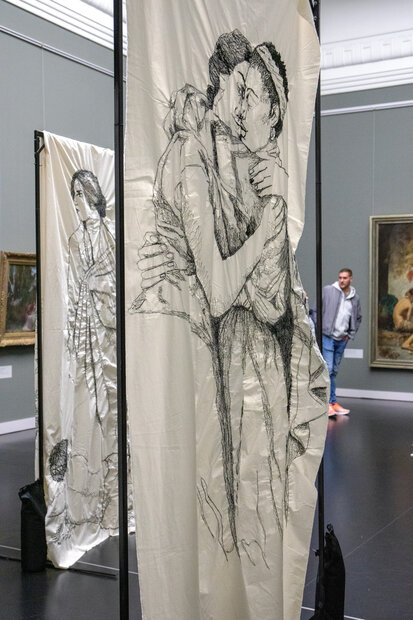
Taking Feuerbach's Hafiz at the Tavern as its point of departure, the work deconstructs the painting's colonial image politics and hierarchical constructions. Figures who remain faceless in the original or appear merely as staffage are given individuality, a face and agency. Their new arrangement creates relationships marked by empathy, tenderness and mutual care. The central position of the Persian poet Hafiz is dissolved in favor of a collective structure.
At the same time the work pushes back against the idea of the artist as an exceptional individual genius creating in isolation from their community. Against this idea it sets an understanding of artistic practice that grounds creative action in community, mutual listening, care and collaboration. Artistic creation appears not as an isolated act but as the result of social relationships and collective processes.
The spatial installation consists of eight freely hanging linen cloths worked with various sewing machine stitches. Several image fragments extract the figures from Feuerbach's original composition and place them in new spatial relationships to one another. The hierarchical pictorial order of the original gives way to an open web of bodies, gazes and encounters.
The materiality of the installation deliberately contrasts with the tradition of painting. In place of canvas stretched tightly over a rectangular frame are freely hanging lengths of fabric whose mobility gives them a sculptural quality. The seam replaces the brushstroke. While the preliminary sketch was traditionally seen merely as a preparatory step in painting, here the line itself becomes an image making element. As a connecting trace between the figures it makes relationships visible and takes the place of the painterly gesture.