
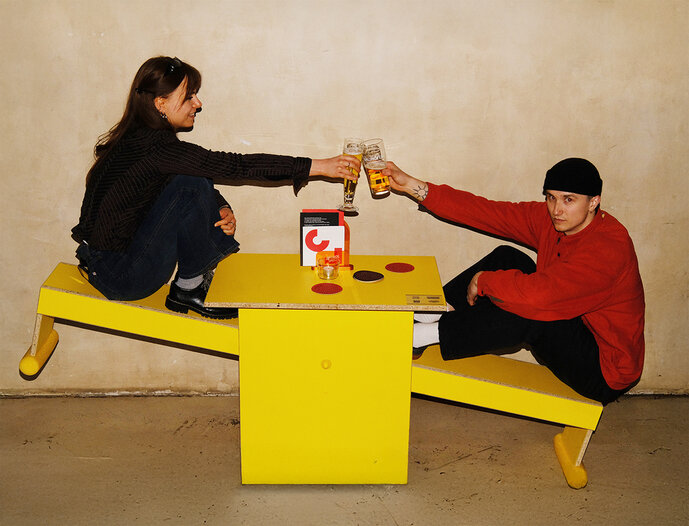
Der Wipp-Tisch verbindet (© Melanie Gloria Wisser)
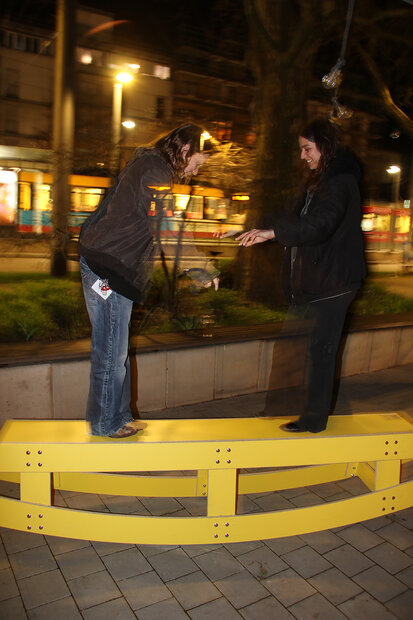
Die WIPP-BANK fördert gemeinsames Zusammenspiel und damit (© Melanie Gloria Wisser)
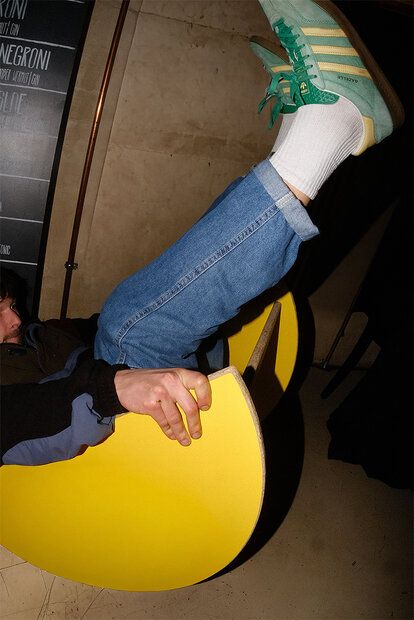
Der WIPP-LOUNGER entstand als Sitzobjekt für soziale (© Melanie Gloria Wisser)
Building on the idea of free play in childhood, PLAY DATE unfolds as a series of studies that explores the discovery of aimless play in adulthood. Often overshadowed by social norms and inhibitions, the urge to play persists as soon as it is given space again.
The starting point was the observation that traditional playgrounds are almost exclusively reserved for children, while adults rarely find space to simply be playful.
© Melanie Gloria Wisser
In PLAY DATE 1, the first experimental playground, the study examined which non-competitive forms of play appeal to adults. The results showed that free play is embraced by adults when the social context is perceived as accepting.
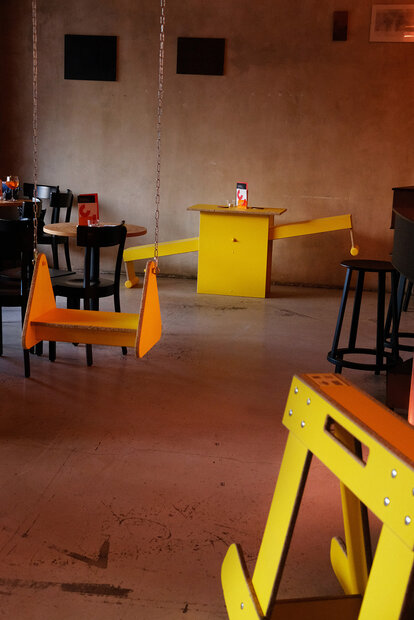
Building on this, PLAY DATE 2 took place in a bar, where playful forms of movement were situationally integrated into the context of social gatherings and convivial get-togethers. Playful gestures could thus be seamlessly incorporated into familiar activities.
With PLAY DATE 3, the exploration was expanded into everyday life: temporary play objects were introduced into the urban landscape to observe how passersby react to unexpected moments of play that disrupt the routine.
PLAY DATE OBJECTS demonstrate how free play can be made accessible again for all ages and open up new social, cultural, and spatial contexts.
Melanie Gloria Wisser is a product designer with a background in craftsmanship. Before beginning her studies at the Academy of Design, she completed an apprenticeship as a cabinetmaker specializing in interior construction. Her hands-on work with materials and construction laid the foundation for her interest in furniture and, at the same time, sparked a desire to go beyond purely functional and craftsmanship-based design. During her product design studies, her focus increasingly shifted toward conceptual questions: What stories do pieces of furniture tell? Why do they have a certain form, and in what context are they used? Her work therefore views furniture not merely as functional objects, but as vehicles for narratives, relationships, and situations.
Many of her projects operate at the intersection of object, space, and social context. Social issues and cultural exchange serve as recurring starting points. Melanie Gloria Wisser views design as an open process in which social dynamics become visible and are incorporated into the development of furniture. For her, social design is a central component of contemporary design.