
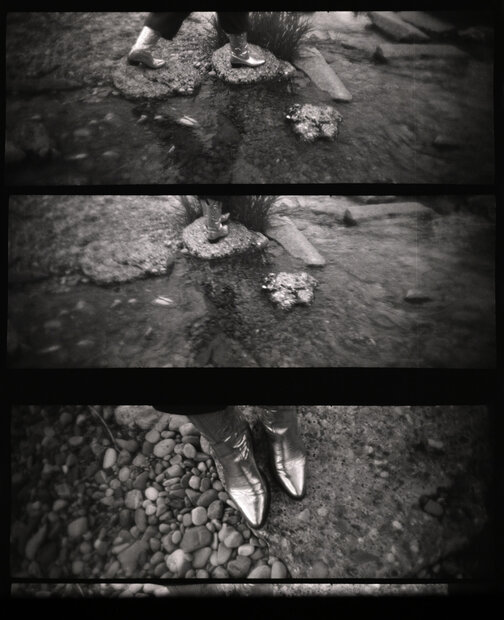
Anda water letters
Since the 1960s, the term Expanded Cinema has encompassed a broad range of film and projection events, performances, and environments. Yet it remains an ambiguous concept, embracing often contradictory dimensions of film and video art. This seminar aims to understand, rethink, and shape the ontology of Expanded Cinema—its mode of being, status, and conditions of existence as both an art form and a practice—with a particular focus on works based on analogue film.
In the practical part of the seminar, students explore how a film can function simultaneously as an instruction and as a performance. Working with the Lomokino—a rudimentary 35mm camera positioned somewhere between photography and filmmaking—they translate short instructional scores into moving images. Drawing inspiration from the instructional works of the Fluxus movement of the 1960s, students create concise, open-ended pieces. While some participants re-enact historical Fluxus scores, others develop their own contemporary interpretations.
Two approaches emerge from this process: documenting the performance of an instruction, and re-enactment, in which the instruction is brought to life anew through the act of filming. Filming itself becomes a performance, while the film becomes an instruction in its own right.
The analogue working method with the Lomokino opens up new creative possibilities through its limitations—its small number of frames and hand-cranked mechanism. These constraints are understood not as obstacles but as productive conditions. The resulting works occupy a space between still photography, performance, and moving image, as well as between documentation, performance, and re-enactment. They are presented as site-specific installations in dialogue with the existing architecture beneath the staircase.
The seminar's central idea is not merely to transcend the boundaries of the image, the screen, or the projection space, but to understand Expanded Cinema as an experience and a concept that can manifest itself cinematically even through non-filmic media. In doing so, it extends the ideas of intermediality and transdisciplinarity: every medium inherently contains elements of other media.
Students ANĐA Anna Schär Kim Gündel Xiaoning Feng Luca Maite Ihns Ruby Balagizi Paula Klaiber Huaynalaya Pauline Friedrich Ada Röderich
Supervision: Maja Milic
Department: Media Art
Works
ANĐA MAIL EVENT (1965, Bici Hendricks) Send water letters.
Anna Schär EATING BUBBLES (2026) Blow bubbles and catch them with your mouth.
Anna Schär CROCHETING VIDEOTAPE (2026) Pull a used videotape out of a cassette and start to crochet it.
Ruby Balagizi NOTHING (1962, Ben Vautier) Performers do nothing.
Kim Gündel DOG ELEVATIONS (2026) A dog at different elevations.
Kim Gündel FALL (Lee Heflin, 1960s) Throw things that are hard to throw because of their light weight.
Paula Klaiber Huaynalaya CRAWLING (2026) Crawl on the ground.
Paula Klaiber Huaynalaya DANCE MUSIC (1963, George Brecht) Gunshot.
Luca Maite Ihns BATHTUB (1963, Ben Vautier) As many performers as possible jam themselves into a bathtub.
Luca Maite Ihns TWO DURATIONS (1961, George Brecht) red green
Luca Maite Ihns FALLING EVENT (1963, Mieko Shiomi)
Let something fall from a height. Let yourself fall.
Pauline Friedrich HOPPING PIECE (2026)
Stand next to something, pause, go on to another thing, pause. When done: run away.
Xiaoning Feng A SUNNY DAY (2026)
Xiaoning Feng THE WORST FILM IN THE WORLD (2026)
Ada Röderich FOLLOW ME AROUND vlog (2026)
Based on: EVENT SCORE (1960s, George Brecht)