
© Anna Manankina
"...that she is the shaped rather than the shaper; the apprentice rather than the master; the atmosphere, the background, the set, the surrounding against which the focused male figure vividly plays out the substantial action of civilization and its discontents."
— Vivian Gornick, referencing Valerie Solanas' S.C.U.M. Manifesto
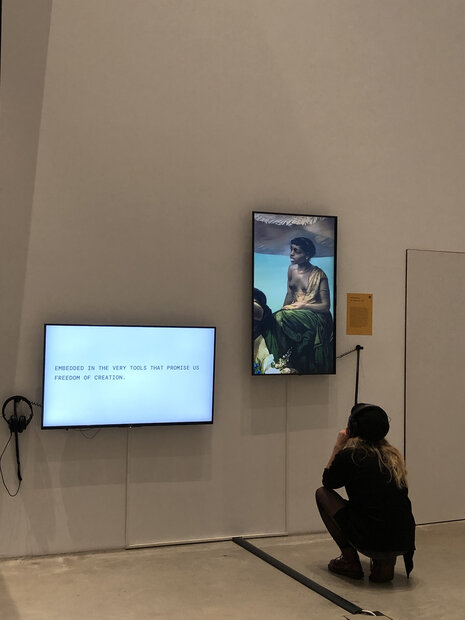
In her project, HfG student Anna Manankina examines how the male gaze is reproduced through AI software, how censorship and sexualization coexist within these systems, and how the notion of "The Great Artist" persists in both historical and contemporary contexts.
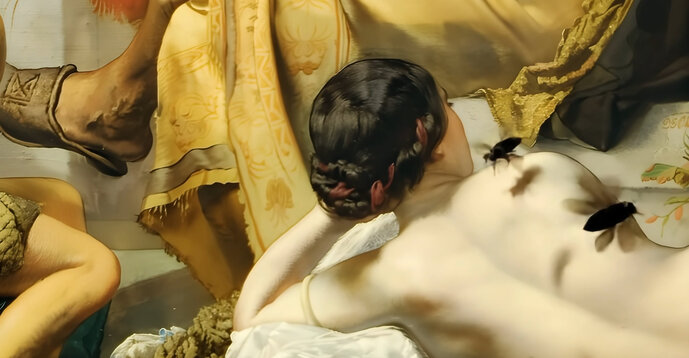
While researching the historical painting collection at Kunsthalle Mannheim, Manankina focused on Anselm Feuerbach's Hafis vor der Schenke (1852), which depicts the Persian poet Hafez reciting his poetry beside two silent, motionless women. Their stillness raises a question: what voices might these women reveal if freed from enforced spectatorship?
The resulting work is a two-channel video installation based on the painting, animated through AI video generation and combined with live audio narration to imagine women's subjective experiences. Theoretically, the project draws on Valerie Solanas' 1967 S.C.U.M. Manifesto, a text of raw anger that became a formative force within radical feminism.
© Anna Manankina
During production, Manankina encountered the guardrails and censorship built into generative AI tools, prompting a central question: can mainstream Gen-AI still distinguish a historical painting from sexually explicit content? In practice, it often cannot — when fed a painting with even a subtle hint of nudity, AI video generators tend to render it in a realistically sexualized way, then flag their own output as "harmful content" and block it.
For Manankina, this reveals an algorithm that is not just inconsistent but shaped by a dystopian, patriarchal logic — echoing 19th-century male artists who elevated the female nude as "Great Art" while strictly confining the roles women were allowed to play within it. The project concludes that these "Frameworks of Fiction" still govern the everyday tools we use, quietly deciding what cultural production is permitted — and what must be cut.