
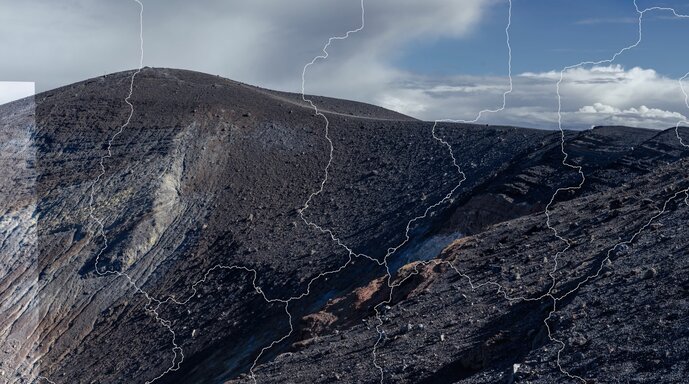
Faulty Lines (© Tobias Ehrhardt)
„The Floor is Lava“ vereint künstlerische Untersuchungen, die aus einer gemeinsamen Auseinandersetzung mit Landschaften als instabilen und umkämpften Orten hervorgegangen sind. Die im Rahmen von Seminarsitzungen, Feldforschung und gemeinsamen Exkursionen entwickelten Arbeiten betrachten die Landschaft nicht als Kulisse, sondern als lebendiges Archiv, in dem sich geologische Prozesse, politische Geschichte, technologische Infrastrukturen und ökologische Beziehungen ständig überschneiden.
Anhand von Bewegtbildern, Installationen, Performances, Robotik und Klang untersuchen die Projekte, wie Orte durch Vertreibung, Ausbeutung, Fürsorge und Vorstellungskraft entstehen. Ein militärischer Übungsplatz wird zum Stellvertreter für ferne Konflikte; Karten offenbaren ihr koloniales Erbe; Architekturen organisieren Bewegung, Überwachung und Ausgrenzung; digitale Werkzeuge legen Spuren von Affekten und unsichtbaren Infrastrukturen frei; spekulative Rituale und Formen der Verbundenheit hinterfragen, wie wir Krisen anders bewohnen könnten.
Mitwirkende:
Peter Albrecht
Ruby Balagizi
Benedikt Endres
Michelle Emmert
Tobias Ehrhardt
Pauline Friedrich
Paula Klaiber Huaynalaya
Jonathan Kramer
Dae Yong Lee
Sukyoung Lee
Daniel Unkel
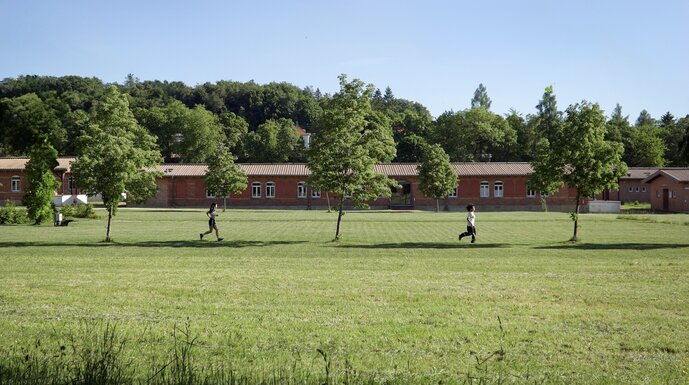
Trees in Formation (© Dae Yong Lee)
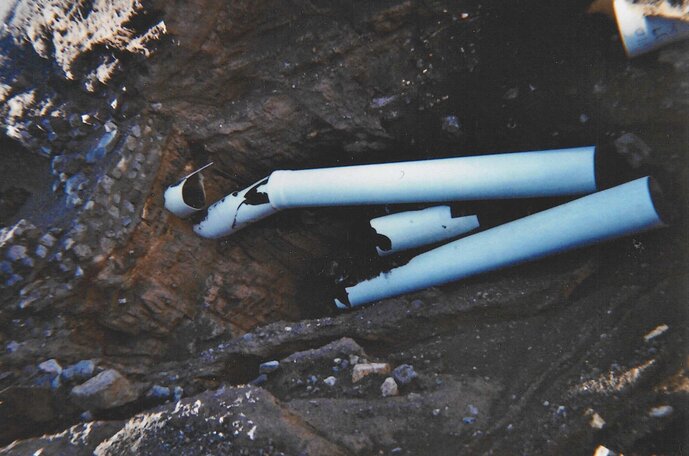
Plumbing the Sublime (© Michelle Emmert)
Ruby Balagizi & Sukyoung Lee
Elsewhere is a reading performance, unfolding around a single shared map - a somatic cartography of two places. In rhythm of words, they trace a correspondence between a former military training ground near Münsingen, its earth worn by tanks, and the floor of HfG, built for the discipline of war. Neither was made for bodies to flourish — yet both carry its marks. Moving between archival fragments, bodily sensation, and speculative imagination, they explore ways bodies could move through these places without pain.
Duration: 15-20 minutes
Date: 17th & 18th of July, at 11am
Place: Under the Lichthof, in front of Blauer Salon
Daeyong Lee
Trees in Formation is a multimedia installation that examines the spatial logic of the former military training area in Münsingen. It explores how architecture and infrastructure shape movement, perception, and the body, revealing how built environments quietly produce order and control.
The installation combines a projected terrain model with video, text, and layered transparent prints of the site. An overhead projection maps the landscape, while the video moves between documentary footage, graphic animation, and personal reflection. Transparent overlays isolate roads, buildings, and repetitive spatial patterns, exposing the organizational systems embedded in the military landscape.
Beginning with the artist’s experience of military service in South Korea and the unexpected familiarity encountered at Albgut, the work traces connections between landscape, architecture, memory, and systems of control.
moving image: 8min
Stellvertreterlandschaft
Tobias Ehrhardt
During its use as a military training ground, the landscape around Münsingen at times functioned as a surrogate terrain. Meadows, roads, and island-like sections of forest were treated as exemplary models. They lost their specificity: no longer this meadow, this road, this plant, but a meadow, a road, a plant — standing in for other landscapes exposed to military occupation, training, or conflict.
This logic of substitution stands in tension with the indexical nature of photography. While a photograph remains bound to the specific site and moment it records, the training ground points elsewhere. It becomes both a concrete landscape and a placeholder for other possible terrains.
Video installation, video loop approx. 5 min, and image fragments printed on affiche paper
Plumbing the Sublime - Evidence of Supposed Flows
Michelle Emmert
Still searching for flows, now running north, Plumbing the Sublime continues its search from the volcanic ground where it began into the Swabian Jura. Near Münsingen, a former military training ground has become a biosphere reserve: an idyll with traces left in its seams. Roads too wide for walking, poured for tanks. A landscape trained for passage.
Beneath the surface, the ground carries its own routes. Posidonienschiefer, the region’s dark Jurassic shale, has been heated for oil, burned into cement, quarried, displayed, and sold back as fossil promise. What is offered as nature, heritage, wellness, or deep time remains entangled with extraction.
The installation is composed of film, text, sound, and a flow. It asks what counts as a flow when the view is also a route, and when the sublime has long been made to supply.
Medium: glas, schiefer, moving image
The Burning Field
Paula Klaiber Huaynalaya & Michelle Emmert
What if one village had to disappear in order to stand in for elsewhere?
The Burning Field is an audio installation for two listeners, unfolding around a single place split between two times. Seated opposite one another, the listeners share a common ground: Gruorn, a village on the Swabian Alb that was cleared in 1937 to expand the military training ground in Münsingen. Later, this landscape also became a proxy for other territories, used to rehearse operations abroad. Today, it is part of a biosphere reserve, crossed by hikers and grazed by sheep. Only the church remains.
Across the two recordings, a shifting walker moves through both times while fully belonging to neither. Where it passes, the sound falters, producing a moment of opacity in which the listeners briefly meet. The piece becomes a space for navigating glitches and cracks, where one time seeps into another.
The installation consists of two seating areas made from gravel. Beside each seat, headphones invite visitors into the layered audio experience.
Medium: headphones, seats
Karlsruhe — Places to Be
Jonathan Kramer
A series of maps trace Karlsruhe from different angles at once. The city is read through its parks and routes, its thresholds and limits — and, running alongside, through something less measurable: the places residents are drawn to, avoid, or quietly call their own. A spot can be a bus stop and also a memory; a street can be both infrastructure and feeling. Karlsruhe is a planned city, its streets fanning out from a single point with the deliberateness of a diagram. But no plan accounts for how a place is actually inhabited — where comfort settles, where unease lingers, which corner becomes someone's private landmark. Across the maps, the designed city and the lived city sit in the same frame, neither one fully explaining the other.
Medium: printed maps
MP3, 12.07.
Pauline Friedrich
A box full of lost property has found its way from a lost and-found- office into the main hall of the HfG. Between the scattered objects lies an MP3 player with a recording, directly addressed to the visitor picking up the headphones. The recording, meant to listen to while moving, aims to direct attention to the fine line between the reality of a room, its origins and its perception. A space's perception may be strongly connected to one's personal beliefs and; or expectations, which the walk wants to broaden by questioning the very factuality of the room itself. Armed solely with the headphones and the player, the listener is led to become the main character of the experience, becoming a performer and a spectator of their surroundings, and especially: themselves in it.
Medium: audio installation
You are being surveilled
Peter Albrecht
In a series of analog photographic prints, You Are Being Surveilled documents and maps different forms of surveillance: cameras, everyday tracking devices, and more abstract systems of observation. Rather than presenting this information as clearly readable text or metadata, the work embeds it directly into the image.
During the analog printing process, selected areas are masked so that simple shapes appear within the photograph. Arranged according to a type system, these circles and rectangles can be read as encoded text after a brief explanation.
The project stages a tension between analog and digital technologies. It addresses contemporary mass surveillance without adopting its own tools, suggesting that older methods may offer ways to observe, record, and resist systems of digital control.