© Maï Diop
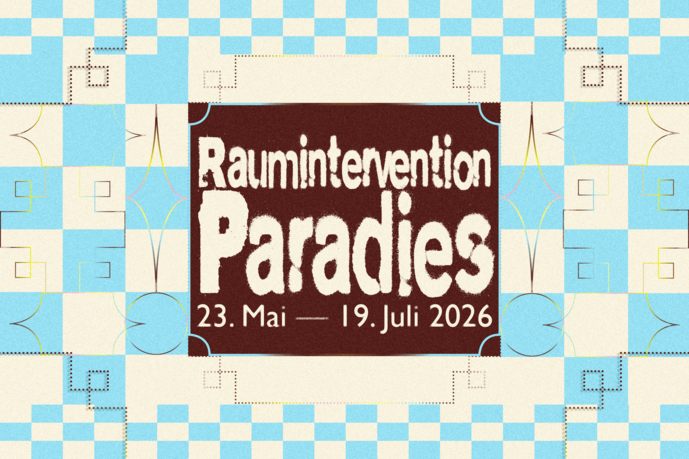
For the next ten years, Hermann-Levi-Platz will remain a vacant urban space surrounded by several major construction sites. For two months, this site will host the spatial intervention Paradise. By naming the square “Paradise,” the project explores the potential of this urban wasteland to become a lively ecological and social space that invites reflection on nature, sustainability, and community. The project focuses on the perception and appreciation of biodiversity in inner cities. The spatial intervention Paradise defines three interconnected places for lingering, learning, and exchange.
At one edge of Hermann-Levi-Platz, plants have created a biodiverse environment. In contrast to the expectations of ordered landscape architecture, this previously overlooked biotope appears untamed and unplanned. Inspired by Gilles Clément’s concept of the “Third Landscape,” the project highlights this biotope within urban infrastructure. Biotopos transforms the idea of paradise from something unreachable into a visible and protected place.
Amid construction sites, examples of paradise are created as inaccessible places — spaces of longing that one can approach, yet always remain distant from. In the center of the fountain basin, the word “Paradise” has been installed. It refers both concretely and abstractly to the site and acts as an invitation to come closer. Paradise appears here as a place for observation and contemplation.
At the K-Punkt, a third part of the project makes paradise tangible as a social space. At its center is a plant exchange platform that encourages not only swapping plants, but also participating in the care of herb gardens. In addition, the surfaces of the area that were unsealed last year have been made more visible. Seating areas have been arranged opposite them, comparable to a museum setting in which artworks can be viewed.
The underlying principle of exchange is simple and open: one person takes what they lack — another gives what someone else needs. In this way, a living cycle of giving, taking, and sharing emerges, making paradise experienceable as a collectively shaped process.
Concept and Realization
Spatial intervention Paradise conceived and realized by students of the State University of Design Karlsruhe:
Doi Yan Chan, Tobias Ehrhardt, Wera Hertenstein, Lorena Karn, Carl Koch, Florian Lips, Chae Young Moon, Rebekka Scheib, Marlon Schuch, Noah Seider, Joscha Thorn, Lola Vorläufer, Linhui Yang
Graphic Design: Maimouna Nele Diop, Benedikt Endres
Seminar led by Constanze Fischbeck
Dramaturgy and Production: Anna Haas and Marlies Kink
Artistic Collaboration: Eva-Maria Lopez