
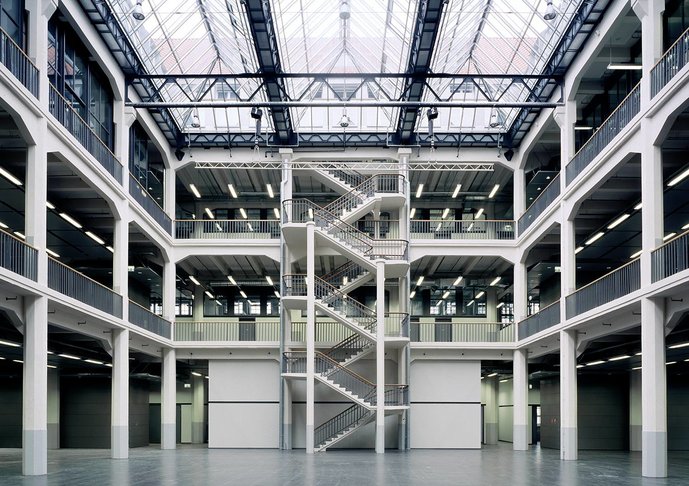
Atrium of HfG Karlsruhe in 2000, Photo: Dirk Altenkirch, www.atelier-altenkirch.de (© Dirk Altenkirch)
The University of Arts and Design (HfG) Karlsruhe was founded in 1992. It was initiated and conceived by art and architecture theorist Heinrich Klotz, who was also the founding director of the newly established Center for Art and Media (ZKM). His vision was to create a place where art, design, science, and new technologies could converge in research, teaching, and practice.
From the very beginning, the HfG was closely linked to the ZKM—a unique combination of university, research institute, and exhibition venue that continues to this day. Building on the reform ideas of the Bauhaus, the goal was to overcome traditional boundaries between theory and practice, as well as between the various artistic and design disciplines.
After its first few years in a former brewery building, the HfG moved in 1999, together with the ZKM, to the hall complex of the former Industriewerke Karlsruhe-Augsburg (IWKA), where both institutions are still based today. This physical proximity facilitates a continuous exchange between academic study, research, and exhibition practice.
Today, the HfG Karlsruhe offers degree programs in media art, exhibition design and scenography, communication design, product design, as well as art history and media philosophy. A defining feature is its interdisciplinary approach: students combine artistic and design practice with theoretical reflection and develop individual perspectives.
In keeping with the HfG’s reform philosophy, all degree programs share the common feature that the focus of the program is on targeted interdisciplinary project work rather than a predetermined curriculum. Approximately 400 students are enrolled at one of the few universities in Germany that offers Diplom or Magister degrees, where they receive the best possible preparation for the professional demands of the working world through a diverse, project-oriented program of study.