
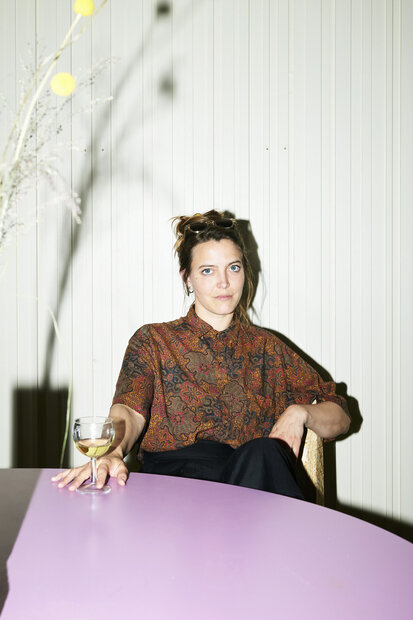
Norina Quinte Porträt, Photo: Sebastian Heck
Hi Norina, you’re an HfG alumna. Please feel free to introduce yourself briefly: What did you study at the HfG Karlsruhe, and when?
I studied art history, media theory, and curatorial practice at the HfG from 2011 to 2018.
How did you first hear about the HfG Karlsruhe back then?
I was in the hospital in Berlin and was bedridden for two weeks. So I started Googling where I could still study for a Magister degree, since the Bachelor’s structure of my program at the FU in Berlin felt very school-like to me. I wanted a more flexible and interdisciplinary option. From the Charité, I wrote my application for Karlsruhe—a dialogue about art between two Berlin housewives.
What appealed to you about the idea of studying art history?
It wasn’t primarily the traditional academic approach that appealed to me; above all, I was drawn to the subject matter covered during the program. I wanted to learn more about art, its various facets, and its historical and cultural-political contexts. And as I said, the interdisciplinary nature of the program and the opportunity to develop practical applications to complement the theory—that’s what really appealed to me.
Your practical thesis at the HfG was titled “Life’s a Pitch” and addressed the format of the business pitch, which is common in the business world—essentially the approach where just a few minutes are enough to convince potential investors of your vision. Was this a topic that particularly interested you in light of the art and culture scene, in which you were already active at the time—for example, through co-founding “die Anstoß e.V.” in 2014—or what motivated you and your project partner Lisa Kuon to choose this topic back then?
Back then, together with the organization “die Anstoß e.V.,” we had developed a well-functioning volunteer-based structure that enabled broad participation and accessible art formats. At the same time, we wondered what the professional and financial future of our industry would look like after graduation. During this period, we delved deeply into funding structures and starting a business (e.g., e.V. vs. GmbH). Admittedly, coming from the art world, this was a bit alien to us. In various settings, we were asked to distill complex ideas into “elevator pitches”—meaning you have to be able to explain your idea to an investor in one minute, or else it’s not eligible for funding. But how do you apply a sales model—one typically used for sneakers or cars—to the art world, which often thrives on complexity? How do you sell a new idea that challenges conventional structures and hasn’t yet proven itself? Back then, we got a pretty wild glimpse into the hell that is pitching. At the same time, those were politically turbulent times at the HfG; there was little clear direction, just a lot of speculation about what the university was “supposed to become.” We took both of these factors as an opportunity to pitch a new university concept and to satirize the demolition and simultaneous rebuilding of a “university of the future.” By the way, at www.artymaniac.com you can still discover some early works by Lisa Kuon and me dating back to 2018, all of which dealt in an exaggerated way with the connection between the art world, advertising structures, and the economy.
Keyword “die Anstoß e.V.”: The association is an independent initiative based in Karlsruhe dedicated to promoting the independent cultural scene and subculture by connecting various interest groups and disciplines—how difficult has it been in the past, and how difficult is it right now in the (socio-)cultural sector, not only to establish such an organization but, above all, to sustain it? After all, it’s no secret—even in Karlsruhe—that arts and cultural institutions, sociocultural organizations, and artists themselves face financial challenges above all else…
It’s definitely not easy. It never has been, but times aren’t exactly rosy—that much is certain. Funding is being cut, budgets are being slashed, and so on. As far as Anstoß is concerned, the city’s landlord recently terminated the lease on the project space at Kronenplatz—a pretty harsh blow. It’s all the more heartening to see that the association’s structures seem stable enough that its active members aren’t giving up but are pressing on. It’s great to see how the association has continued to develop—even when some of us from the founding team became less active or moved away from Karlsruhe, it kept going. The association is doing fantastic cultural work here and defying the current challenges. I myself am also professionally active to some extent on the “other” side—for example, I’m a member of the external advisory team for the city’s future cultural strategy. Here, in turn, I’m learning about the complex challenges from an administrative and institutional perspective. The arts (unlike other industries) have too small a lobby, especially when it comes to the independent scene—this is generally very noticeable. Added to this are global and political challenges...
At the HfG, you’re still best known as the initiator and developer of “Sozial & Durstig”—what do you particularly enjoy about creating multifunctional spaces for people to come together?
Interaction and exchange are essential for creating quality content and people-centered innovations. I firmly believe that this makes projects more multifaceted and fosters constructive criticism. That’s what drives me in all the projects I curate, lead, or initiate. Sozial & Durstig was no exception: It was during the pandemic; many faculty members weren’t in town, and many students had just started their studies amid this vacuum. The idea of a communal space with a cafeteria vibe had been a topic of discussion at the school for a long time, even back when I was still a student. And that’s why it was so important to me to establish it when I started at the Rector’s Office. Besides, projects appeal to me all the more when someone says they’re “unfeasible.” That makes me curious, and I think, “Well, let’s see about that.” But this story also shows that we constantly need people who keep such structures alive—despite bureaucratic objections.
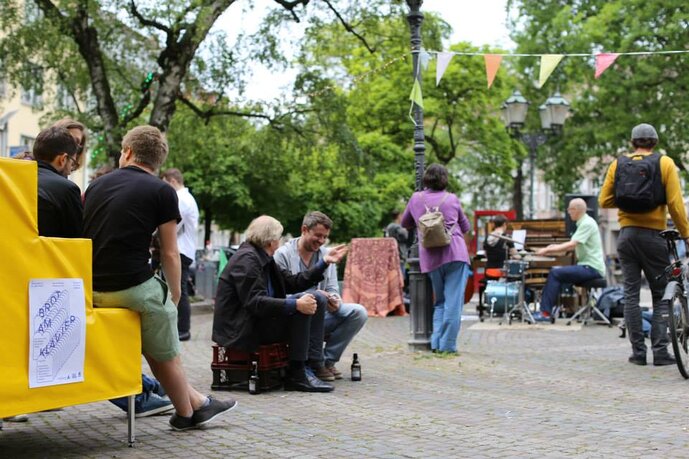
Anstoß e.V., Photo: Norina Quinte
Since 2019, you’ve also been known and active as a (co-)founder of ato (www.ato.vision and agentur.ato.vision): What motivated you and your co-founders to launch this agency?
All the experience we’d gained up to that point, as well as the interdisciplinary dialogue you mentioned, played a role. We asked ourselves: Beyond museums and galleries—where we work professionally—what else exists in the art world for those of us who want to engage with art and artists? What are the working conditions like? (For artists as well as curators and art educators.) The more deeply we explored these questions, the clearer it became: The art market operates in a rather opaque and elitist manner; the system only works for a select few. So how can we create new avenues of access, think more collaboratively, and redistribute structures differently? And where else, beyond the traditional gallery or museum space, could art still have an impact? These questions sparked our initiative.
What’s the story behind the name “ato”? How did it come about, and is there any significance behind it?
“ato” was one of the most concise words with no specific meaning. “vision” is simply the suffix of our web domain and a reference to the project’s supposedly utopian nature. Sometimes we think about other names. Maybe that will happen someday.
Who do you or your team at ato collaborate with?
The network is expanding in many directions. Within our gallery structure (www.ato.vision), we work with curators and their artists. Beyond that, we represent a large network of creative professionals and people from completely different fields, including, for example, IT, robotics, architecture, and product design. We represent these individuals within the agency (agentur.ato.vision). And then there’s “CRISP,” our critical art magazine, where we collaborate with freelance editors. There are also many people with ties to the HfG on the team, such as Jannik Lang, Adam Gawel, Hannah Cooke, Stefanie Rothe, Alex Besta, Kilian Kretschmer, Francis Karat, and many more.
What does it take to become part of ato as an artist?
Artists who would like to be represented by ato can contact our art agents and then apply together. We have an external committee that decides on admission. Freelance curators can also apply to represent their own artists. If you’re from another field and would like to collaborate with us on projects, simply reach out directly, and we’ll see if it’s a good fit and where your expertise can best be utilized. We sometimes collaborate with students as well; in these cases, the committee also decides on admission.
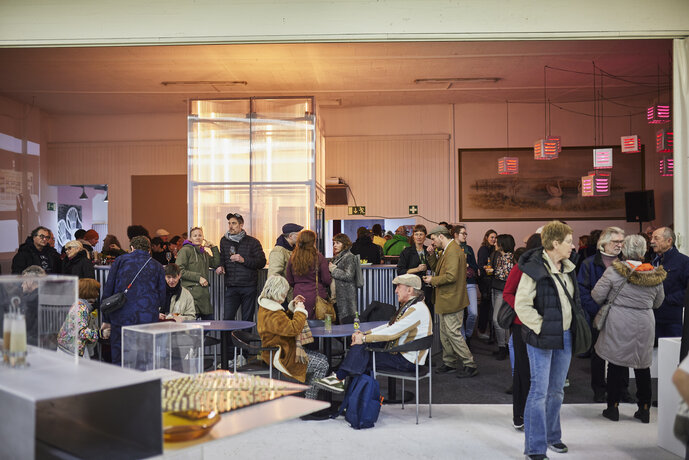
Artini Bar von atovision im Rahmen der art Karlsruhe 2025, Photo: ato vision
Since the summer of 2025, the interactive art installation “Flora Momentum”—curated by you and HfG alumni Jannik Lang and Hannah Cooke—has been on display at Stephansplatz in Karlsruhe: it was originally conceived as a temporary neighborhood initiative as part of the City Transformation Karlsruhe project, was at times ridiculed in the local press, and was even perceived as disruptive (taking up too much space). It is now a permanent fixture on Stephansplatz. How did you—or rather, how did all of you—deal with the backlash back then, and with what turned out to be a very unexpected 180-degree turnaround and success story?
That was a nice twist for us, too. To be honest, we had already anticipated such media coverage—typical of Karlsruhe—and assumed the work would be taken down after three months. But the result clearly shows that when places are beautified or revitalized through art, even parking lot enthusiasts don’t stand a chance. The process took on a life of its own, because more people—from residents to mayors—spoke out in favor of keeping it than there were complaints. The impact of the intervention spoke for itself; the site became an inner-city gathering place. We’re all still very happy whenever we walk by.
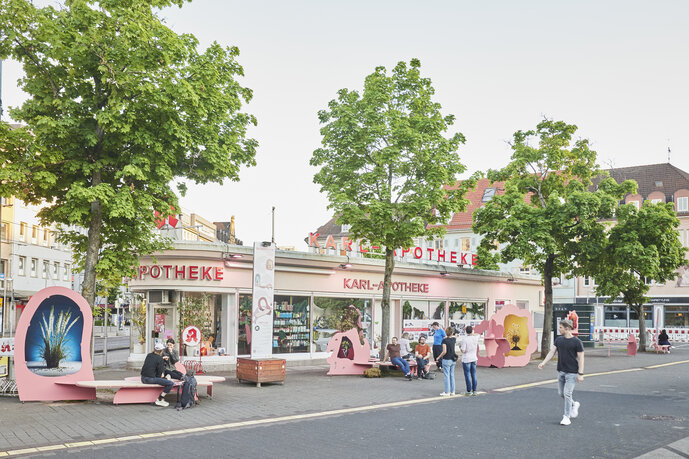
Flora Momentum Installation Stephanplat Karlsruher Innenstadt
In your opinion and based on your expertise, why is art in public spaces necessary at all?
It creates “third places” (in addition to workplaces and homes), it stimulates thought, it brings people together, and, at its best, it also enhances the environment aesthetically. Art in public spaces ensures that culture is accessible even to people who don’t want to or can’t go to a museum. It also provides moments of surprise, which in turn lead to new perspectives.
How do you view Karlsruhe as a city of art and culture compared to other cities? Especially in light of your many years of involvement and your work in this field?
Karlsruhe certainly has its share of unique features. Among them, of course, is the connection between its status as a technology hub and its high concentration of artists. In terms of both content and history, this mutual proximity creates interesting tensions. Also interesting: Karlsruhe has major cultural landmarks and, at the same time, many small alternative venues. What I find unfortunate, however, is that this cultural diversity isn’t really reflected in the cityscape. It would be great if there were more life on the streets. Other cities are more open in this regard, allowing for more open spaces where urban society and culture can intersect. Unfortunately, Karlsruhe has a knack for redeveloping exciting open spaces in a way that stifles them, rather than developing them in an interdisciplinary and process-oriented manner. In the long run, this drives the interesting, innovative players to other cities or fields of work.
What potential do you still see here in Karlsruhe for art in public spaces?
In recent years, a number of highly dedicated individuals have joined the city’s cultural administration. This is encouraging and brings a breath of fresh air. Thanks to this commitment, the city has also launched new initiatives such as the publicly accessible “Kunstrauschen” and has actively revitalized platforms like “Media Art Is Here.” I see great potential, especially in the collaboration between independent artists and the city administration. If this collaboration is intensified, Karlsruhe’s public spaces could become an exciting and diverse cultural landscape. However, the word “potential” is also misleading, as it shows just how much remains untapped ;)
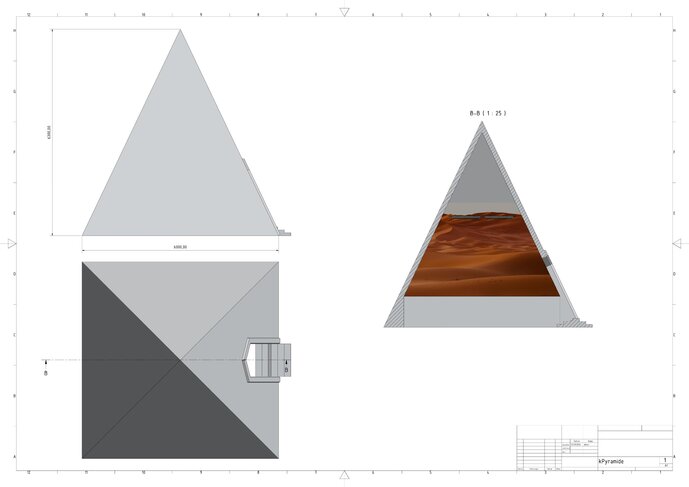
Pyramide - Projekt für City of Media Arts Karlsruhe 2026
In 2025 and this year as well, you’re serving as curator of the Rhineland-Palatinate Triennial, and you’ll continue to work for ato—may we ask what you’re currently working on, or what projects are coming up soon that we can look forward to?
Curating and conceptualizing the first Rhineland-Palatinate Triennial was an exciting experience; the project phase ended in June 2026. But now I’m also looking forward to bringing something to life in Karlsruhe again. A question I’m currently grappling with is: What does a city like Karlsruhe need more urgently than anything else in the world during the crisis-ridden year of 2026? Clearly: a second pyramid. So we—that is, media art by VOLNA in collaboration with Andreas Hölldorfer (KA) and Studio Belwerk (Leipzig)—will build a second pyramid on the market square in August, as part of the UNESCO City of Media Art Initiative. Unlike the original city pyramid, however, ours will look toward the future.
All in all, would you say that studying at the HfG met your expectations, and would you choose to study art and design again if given the chance?
No, the program didn’t meet my expectations, because, to be honest, I didn’t have a clear idea of what to expect. I was just drawn to it. And yes, especially for people for whom freedom and interdisciplinary work are fundamental needs, the HfG is an incredibly enriching place!
How did the transition from your studies to your professional career as a curator go for you—were there any challenges you didn’t expect?
I had my son shortly after graduating—that was probably the biggest surprise. At the same time, I was curious about the working world, so in addition to founding ato, I took over the management of KAMUNA (Museum Night). This was followed by my work in the HfG’s administration office and the development of WERKstattPALAST in the Rhine Harbor, a 10-week festival held in a large, purpose-built architectural structure. So quite a lot right after college—no gradual transition into the working world. All these experiences remain incredibly diverse to this day, and each one brings its own set of completely different challenges. I appreciate the unexpected.
Looking back from today’s perspective, what would you like to shout out or advise your first-semester self?
Enjoy it, carve out some personal space, be politically engaged, and don’t let others’ name-dropping get to you.
THANK YOU for the interview!
More about Norina Quinte can be found here Or here: atovison Webseite Or here: atovision Instagram

