
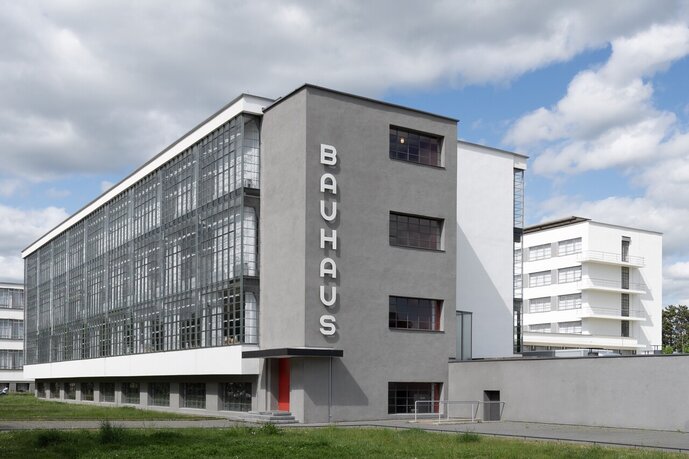
Bauhaus Building (1925–26), Architect: Walter Gropius, Evening scene from the “Collecting Bauhaus” conference, 2019, Bauhaus Dessau Foundation / Photo: Thomas Meyer, 2019 / OSTKREUZ
HfG Karlsruhe supports the Bauhaus Manifesto 2026, thereby taking a stand for freedom, openness, creativity and social responsibility.
The Bauhaus stands like few other cultural institutions for the power of art, design and interdisciplinary thinking to help shape social developments. At the same time, its history reminds us how directly cultural freedom and democratic values are interconnected: The persecution and closure of the Bauhaus by the National Socialist regime demonstrate impressively how threatened free art, education and cultural institutions can be when democratic and pluralistic principles come under pressure.
As a university of art and design, we see ourselves today as a place where different perspectives, disciplines and positions come together. The freedom of art, science and teaching is a fundamental prerequisite for this.
Freedom Needs Open Spaces
A university of art and design thrives on the possibility of asking questions, developing positions, tolerating dissent and trying out new paths. Especially where social developments are controversial, spaces for open and respectful exchange are needed.
Artistic and academic work must not be reduced to providing immediately usable answers. It creates opportunities to question what exists, make other perspectives visible and think beyond what is supposedly self-evident.
Protecting this freedom also means opposing attempts to politically appropriate, restrict or delegitimize art, science and cultural institutions.
Design Is Social Practice
The Bauhaus shaped the idea that design cannot be understood separately from social conditions. This perspective remains of central importance to HfG to this day.
Design, art and media shape our environment, our forms of communication and increasingly also the digital and technological systems in which we move. They influence who becomes visible, who gains access and how social reality is perceived and understood.
Design therefore requires not only aesthetic and technological expertise, but also social responsibility. HfG understands design as a practice that engages with real-world conditions and always asks the question of how we want to live together.
Interdisciplinarity as a Strength
A key idea of the Bauhaus was the connection of different disciplines, perspectives and forms of knowledge. HfG Karlsruhe is also committed to this idea.
The connection of art, design, theory, research, technology and social practice creates a space in which new ideas can emerge. Interdisciplinarity does not simply mean collaboration between different fields, but also the willingness to repeatedly question one's own methods and assumptions.
At a time of complex social, technological and ecological challenges, this openness is more important than ever.
Remembrance as Responsibility
The history of the Bauhaus reminds us not to take cultural freedom for granted. A culture of remembrance therefore means more than preserving historical events. It provides orientation for the present and helps us assume responsibility for the future.
As a university, we see it as our task to critically reflect on history and to create spaces in which different experiences and perspectives can become visible. This also includes engaging with the mechanisms of exclusion, discrimination and political influence.
Openness to the World and Diversity
The Bauhaus was a place of international exchange from the very beginning. People with different backgrounds and experiences shaped its development. This openness is part of its lasting legacy.
HfG Karlsruhe also sees itself as an international and diverse university. Exchange, migration, different cultural perspectives and collaboration across borders are not a threat, but a prerequisite for creative and social development.
An open society needs places where diversity is not merely tolerated, but made productive. Universities, art and cultural institutions are among these places.
For a Culture of Openness
The Bauhaus Manifesto 2026 reminds us that art, design, education and culture bear social responsibility. HfG Karlsruhe stands for a culture that enables freedom, allows for differences, tolerates criticism and generates new perspectives.
We therefore support the Bauhaus Manifesto 2026 and affirm our commitment to an open, democratic and diverse society.
For the freedom of art, science and teaching. For interdisciplinary thinking and action. For an open and diverse culture. For spaces where something new can emerge.

