
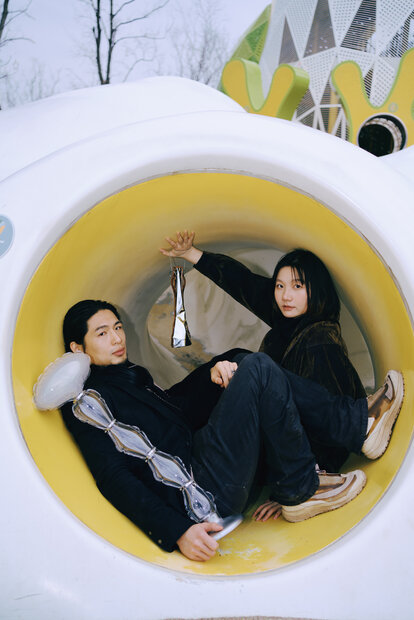
Zhen Bian (links) und Qian Chang von Studio Ololoo
In conversation with Zhen Bian.
Hi Zhen, you're a HfG-Alumnus. Please feel free to introduce yourself briefly: When did you study at the HfG Karlsruhe, and what was your major?
Hello, I’m Zhen and I’m from China. My studio, which I run with my girlfriend Jaco Qian, is called Studio Ololoo. Before coming to the HfG, I already had a bachelor’s degree in industrial design and a year of professional experience at a design agency. From 2018 to 2023, I studied product design at the HfG Karlsruhe.
What motivated you to study at our university?
I decided to study at the HfG Karlsruhe—or rather, to study in Germany—because I have a great passion for design, and I felt that I had already learned everything important at a design agency and had reached a point in my career where I could no longer make further progress. Before applying to the HfG, I took a close look at the work on the university’s official website as well as the professional backgrounds and portfolios of the individual professors—and I realized that this was exactly what interested me. That’s why I ultimately applied to the HfG.
How did you first learn about our academic programs?
Before I came to Germany, I read a book that highlighted outstanding German design academies. I then researched all the design academies recommended in the book in detail.
What was the application process like for you as an international student?
Students from China, Vietnam, and Mongolia need an APS certificate to study in Germany. It serves to verify the authenticity of previously earned academic credentials, and the entire process is very time-consuming. Aside from that, I didn’t encounter any other difficulties: The application process at the HfG Karlsruhe is very simple and user-friendly.
Before coming to the HfG, you studied industrial design in China: What made you decide to come here?
In Chinese design education, German design has long been held up as something special. Back then, I wanted to study design at the best place in the world—and that’s why I came to Germany.
How different are product design and industrial design from one another?
Basically, there aren’t any major differences between industrial design and product design. The only difference is that industrial design focuses on industrial mass production. Even today, I regularly take on projects in the field of industrial design. There are also universities in Germany that offer degree programs in industrial design—I have friends who are studying there. However, their understanding of design is less comprehensive than ours; they generally do not delve deeply into aspects such as material properties or natural phenomena. Instead, they primarily work with computer-aided modeling, rendering, and 3D printing. In contrast, at the HfG we are encouraged to bring our designs to life ourselves in the workshops. This hands-on experience in the workshops has been incredibly valuable to me: it has helped me become thoroughly familiar with the properties of materials and the corresponding manufacturing processes. As far as education in the field of industrial design is concerned, there are no significant differences between China and Germany. I am very glad that I chose the HfG Karlsruhe and the Product Design program.
During your time at the HfG, you completed an internship with the renowned Dutch designer Marcel Wanders. How did that come about, and what was the experience like for you? How much did the internship influence your further development at the HfG Karlsruhe?
It’s a long story. When I first arrived at the HfG, I was struggling with my studies. A professor asked me which designers and artists I liked. I replied, “Le Corbusier.” I didn’t know any contemporary European designers and had no idea what they were working on. That was the problem. So I got into the habit of regularly watching lectures by European designers on YouTube, looking at their work on their websites, and analyzing what was good about their pieces. That helped me a lot. During that time, Marcel Wanders became my favorite designer. When I was looking for an internship, I applied to his studio—and I got the acceptance on my birthday. That was the best birthday present. The biggest impact the internship had on me was that it helped me determine my career path. I can say that at the HfG we learn experimental design. It’s interesting and I really like it, but it’s not compatible with the market. Before I left the studio, I asked Marcel Wanders the following question: “Experimental design is interesting, but I can’t make money with it. With commercial design, I can make money, but it bores me.” He replied, “You can do both—that’s how I do it, too.” Commercial design and experimental design have common ground, but in most cases, I’m not allowed to mix the two. I am very grateful to Marcel Wanders for telling me that, and I still follow that approach to this day.
In which country and city do you currently live and work?
I’m from Hangzhou, China, but I now live in Ningbo. It’s a port city where people speak the same dialect as in Shanghai. There are many factories around Ningbo. In the past, they manufactured products exclusively for other brands, but today they’re also building their own brands. They could become my clients.
With your lighting design “Deformation Under Pressure,” which was also your thesis project, you’ve won several awards. For example, first place at the SaloneSatellite Award 2024 during Milan Design Week, the award for the most experimental design at Design Shanghai Talents 2024, and the Dezeen Awards China in the Furniture category in 2024: a huge success! Looking back, what do these awards mean to you? Have there been any other awards since then?
Winning awards is a form of validation for me. They show me that I’m on the right track. But I don’t want to rest on my laurels and stand still. I’d rather focus on new projects. Last year, I won the Khalil Design Award. I’ve seen that other students at the HfG have also received this award. In fact, I’ve already won many awards in Asia. But since these awards aren’t very well-known internationally, I don’t advertise them much. This year, I’ll also be receiving some international awards, but the organizers have asked me to keep this under wraps for now.
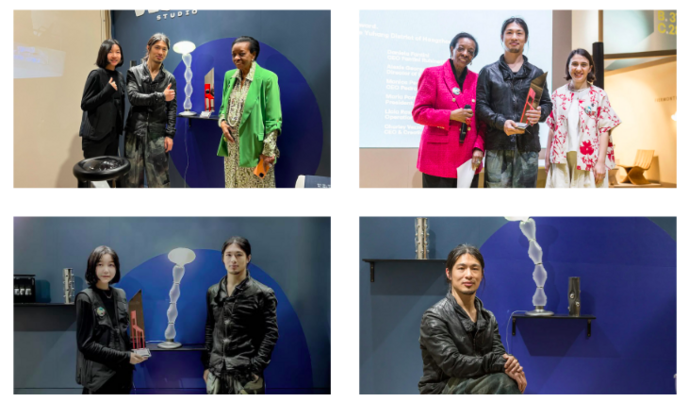
Zhen Bian - Prizes 1st Price Award Salone Satellite 2024, Milan Design Week 2024
And how have things been going for you and the lamp since then? Are you still exhibiting it and refining the design, or do other projects take priority right now?
Originally, I wanted to produce and distribute the lamp myself, like other European designers. But the manufacturing process was very complex, and after making four units, I lost interest. In 2025, I put the whole thing on hold. For me, designing is more important than selling—my personal projects don’t necessarily have to make it to market. I only recently resumed production after a friend told me, “You absolutely have to keep your masterpieces in your own hands.” I’ve revised the design to make it more suitable for industrial production. Like Chris Kabel and Bertjan Pot, I want to realize projects out of interest and with diverse themes. I don’t intend to constantly develop new inflatable lamps. Right now, I’m mainly working on commercial projects. That’s why I only have enough time each year to complete exactly one personal project.
How did you actually come up with the idea to design a lamp for your diploma project back then?
My research project at the time focused on soft, inflatable materials and the effect of pressure on them—and what functional objects could be created from them. The lamp is one of the results.
Can you tell us a little more about the lamp—what’s the concept behind it, the material, etc.?
Inspired by the way soft materials deform under pressure, this project explores tension and deformation and integrates these concepts into the product’s function. The lamp is made of recyclable TPU. The inflatable body is divided and held in place by rings. The structure, which is tensioned by thin wires, can be held in any position through friction. This allows the height of the lamp to be easily adjusted by pulling—without any conventional mechanical systems or swivel joints. When the body is folded up after the air is released, it can be easily transported or stored to save space.
What particularly fascinates you about the topic of lights/lamps?
I don’t design lamps. The lamp is merely the medium through which my research project ultimately finds expression—it simply emits light. In fact, I don’t yet have enough knowledge about light and lighting and am still in the process of learning about it.
You were just back in Milan for Milan Design Week—how was it, what was your assignment there? Did you exhibit anything?
I’m in Milan just to show my new projects—it’s not about sales. If I didn’t exhibit them, no one would know what I’m working on back home, haha. This is very important for all the designers at the HfG. Our school has so many talented designers, and they should show what they’re doing. If the projects are good, opportunities will come naturally.
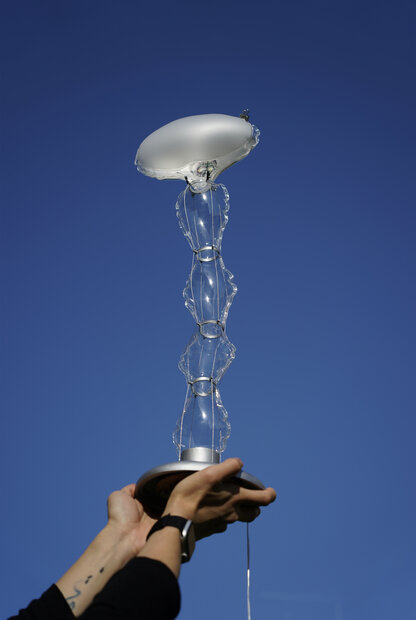
Bubble Lamp "Deformation under Pressure", winner of, among others: SaloneSatellite Award 2024 während der Mailänder Designwoche, des Preis für das experimentellste Design bei Design Shanghai Talents 2024, des Dezeen Awards China in der Kategorie Möbel 2024:, Photo: Zhen Bian
May we ask what you’re currently working on?
My work is divided into three areas:
- Developing numerous products for Chinese factories—that’s my main source of income.
- Designing furniture or lighting for established brands (there are usually only one or two such projects per year).
- Personal projects that I undertake out of my own interest.
When you think back on your time at the HfG, what would you say the university taught you that is particularly helpful to you in your professional life now?
I do research-based design. That’s a skill that many commercial designers in China and even in Italy don’t have—and that makes me competitive. I’m familiar with manufacturing processes and materials. Basically, industrial machines operate on the same principles we learned in the university workshop. So when a client tells me that a design isn’t feasible, I can immediately suggest a suitable solution. I can also solder circuit boards. This allows me to build prototypes myself without having to rely on factories.
Were there any instructors or courses that had a particularly strong influence on you?
At the HfG, Professors Mario Minale and Chris Kabel had the greatest impact on me. Mario showed me how to discover interesting phenomena in everyday life and translate them into design through research. Chris sets very high standards for innovation and always pushed me to further develop and perfect my projects. Without them, I wouldn’t have achieved the success I have today.
How did your studies change your professional or personal outlook?
Before I came to the HfG, I focused solely on fulfilling clients’ wishes. During my studies at the HfG, I gradually developed an interest in conducting my own research. Today, I have a deep passion for my own projects. My personal projects are one of my main priorities—if I don’t have time for them, I don’t feel right.
Is there anything from your time as a student that you don’t miss at all?
No
What would you say or advise your first-year self at the HfG?
Our university is very open-ended, so you shouldn’t expect a systematic foundational design education that prepares you for everything. You should therefore also explore design history outside of seminars, for example. The book “Design: History, Theory, and Practice of Product Design” by Bernhard E. Bürdek is a great example and helped me a lot. Because in addition to experimental projects, you also need to be able to execute commercial projects. After all, it’s a real shame when a good designer gives up design just because they don’t know how to make money from it.
If you could give future international students one piece of advice, what would it be?
If they already have a design-related education, I advise them to set aside all the skills they’ve learned for the time being. They should see themselves as beginners and be open to absorbing the knowledge at the HfG. The HfG is intended for people who truly have a passion for design—not as a stepping stone to making more money later on.
Would you say that studying abroad opened doors for you—and if so, which ones?
I can easily imagine that I’d be working as a creative director at some design agency today if I hadn’t come to the HfG. Thanks to my experience in Germany, I’ve developed a much deeper passion for design and am doing exactly what I truly enjoy. Maybe it’s because I’m a foreigner—in any case, I didn’t just focus on Germany, but turned my attention to all of Europe and my home country, China. That really helped me develop my thinking about design and my professional career.
Thank you for the interview!
You can find out more about studio ololoo here
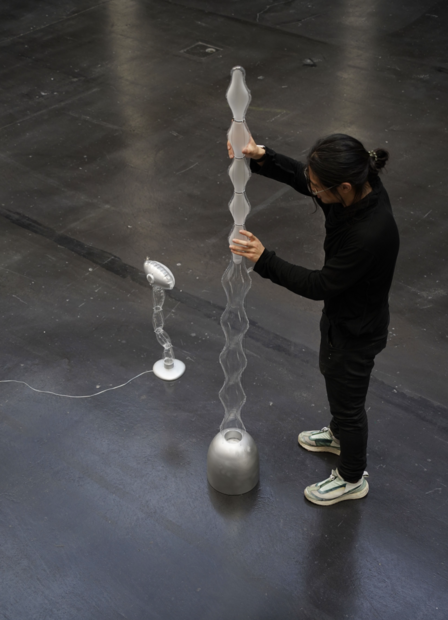
Zhen Bian an der HfG Karlsruhe mit seiner Diplomarbeit "Deformation under Pressure"

