
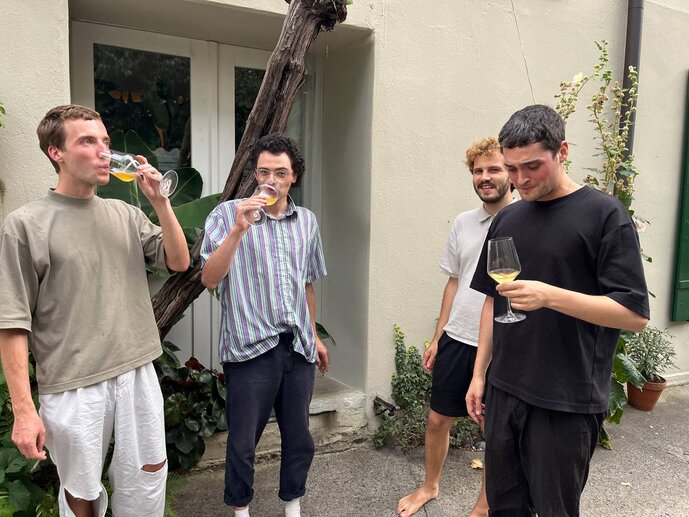
Gruppo Due aka Moritz, Bruno, Massi and Jonas. (© Gruppo Due)
In conversation with Gruppo Due aka Moritz Appich, Bruno Jacoby, Massimiliano Audretsch und Jonas Grünwald.
Hello GruppoDue! All of you—except Jonas—are HfG alumni—please introduce yourselves briefly: Who
are you, and where can we find you these days?
Hello, we are Bruno, Massi, Moritz, and Jonas. Together, we work as the type foundry Gruppo Due, and we also pursue our own independent design and artistic projects. In addition to his design practice, Massimiliano has been a professor of typography at the HSD in Düsseldorf since last year. Bruno lives and works in Offenbach; in addition to his freelance work, he is an artistic staff member at the HfG Offenbach in the Type Design program. Moritz lives and works as a freelance designer in Berlin. Jonas is based in Karlsruhe and works as a developer alongside his independent artistic practice.
What did you study at the HfG?
Bruno, Massi, and Moritz all studied Communication Design. Jonas is an old friend of Bruno’s. He is the only one who did not study at the HfG Karlsruhe, but funny enough, he is now the only one of us who lives in Karlsruhe.
What motivated you to pursue an artistic degree at the start of your studies?
We all ended up at the HfG somewhat by chance, but quickly realized that we were more interested in a freer form of study than an applied one. Above all, the interdisciplinary and open structure that spans semesters encouraged us early on to develop independent projects. The HfG’s infrastructure, as well as the joint seminars with students from other departments, formed an essential foundation for both our individual and collective artistic practice. This environment gave rise to long-standing friendships and connections that continue to shape us to this day and remain an important part of our collaboration.
How long has Gruppo Due been around? And what’s the story behind the name?
We founded Gruppo Due while we were still students, in 2020. Rumor has it that the name comes from a piece of graffiti in a bar on Werderplatz, Karlsruhe.
What is the idea behind the collective, and why did you start it?
During our studies, we frequently worked on typefaces in seminars and on our own projects. To make these accessible to a wider audience, we joined forces and founded Gruppo Due. Our goal was to create a shared platform that would allow us to publish our typefaces and projects independently. Coming together under the name Gruppo Due has made us more visible and opened up new forms of collaboration. From the very beginning, it was important to us that Gruppo Due also be a space for freer and more experimental ideas—a platform where we can publish and test new approaches and tools. At the same time, our collective structure allows us to focus on developing and finalizing our typeface projects while supporting one another throughout the process.
Who can interact or collaborate with you, and how?
We’re open to collaborating with anyone in any way—feel free to just send us an email! We always look forward to exchanging ideas and are currently developing a structure that will allow us to publish typefaces in collaboration with external designers. We find direct interaction with students particularly exciting, for example in workshops or seminars, as this creates an open space for experimentation, discussion, and new perspectives.
What fascinates you most about the subject of typography?
For us, typography and type design are extremely versatile tools. They not only organize information into a decodable and readable format, but also possess immense, subtle, emotional, and poetic potential. Typography is the visual representation of language. How a sentence is set, the context in which it appears, and how it relates to other information significantly influence how it is read and understood. The individual letter, as the smallest designable unit, forms a larger whole when combined with others. It is precisely this relationship between detail and the big picture, between micro- and macrostructure, that we find particularly exciting. Type and layout are always also an expression of the respective technology, the cultural context, and the social ideas in which they arise—and which change and are renegotiated over time.
What is your type design process like?
Since we work not only as type designers but also as graphic designers, our typefaces usually emerge from specific applied projects and our own design practice. Type design is an exciting tool for us to translate a project’s conceptual and artistic ideas into a distinct, project-specific visual identity. The approaches and designs developed in this process often form the basis for typeface families, which we then further refine for
commercial release. For example, G2 Ciao emerged from Massimiliano’s thesis project, while G2 Erika was created during a seminar at the HfG. Our process is usually heavily research-based, though we are less interested in classical type history than in serendipitous discoveries, anomalies, minor inconsistencies, and inspiration from other disciplines.
Do you work continuously on new ideas, or are there specific triggers for typeface development?
Over time, we’ve had to continually develop new strategies for our collaboration—especially when it comes to creating typefaces and further developing our website. When Gruppo Due first started, we all lived in the same place, which gave our collaboration a shared rhythm and made our interactions feel very natural. Now, in addition to Gruppo Due, we each pursue our own projects and therefore work on individual tasks and typeface families with varying degrees of intensity. However, this is precisely why we benefit from a
clear division of labor: We support one another, take on specific tasks, and can organize workflows flexibly. This structure allows us to continue working seamlessly despite different locations and schedules.
Is there a font you would never use or that you find absolutely awful? Or are there typographic designs in public spaces that make you cringe? Fonts aren’t inherently terrible, just like colors or letters. Of course, there are trends and tastes, but what’s always more interesting is how the fonts are used and what’s written in them. What bothers us tough is the now far-advanced commercialization and branding of public spaces and cultural institutions, which leaves no room for friction.
What are you currently working on as Gruppo Due (if you’re allowed to talk about it ;))?
Sure, of course! We’ve just finished two commissioned projects. A new corporate typeface for the Design Museum Gent in Belgium, in collaboration with the design collective 019. And a typeface focused on hyperlegibility for the imai Foundation in Düsseldorf. Both typefaces will be made available to everyone for free under an open-source license. They can then be downloaded from our website.
What did you take away from your studies at the HfG that particularly helps you in your day-to-day work today?
The often-cited interdisciplinarity and the exchange with all the other students, regardless of their departments, is something we sorely miss. And something that is often underestimated: the physical space of the HfG is something truly fantastic, despite its quirks. Everyone is together in one large building and can come together.
What would you say to your first-year self today?
Try even more things, and go to France more often!
Thank you for talking with us!
More info about Gruppo Due can be found here:
Website: https://gruppo-due.com/
Socials: gruppo.due
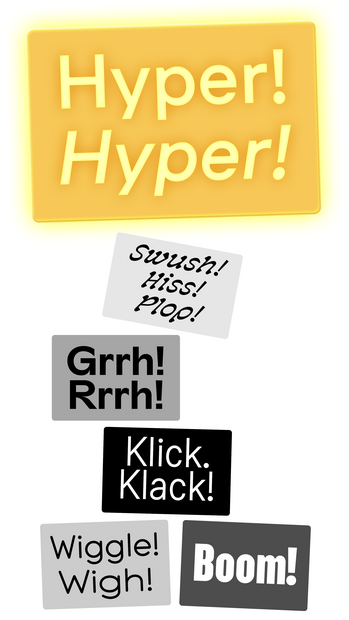
Gruppo Due Schriften, Photo: Gruppo Due

