
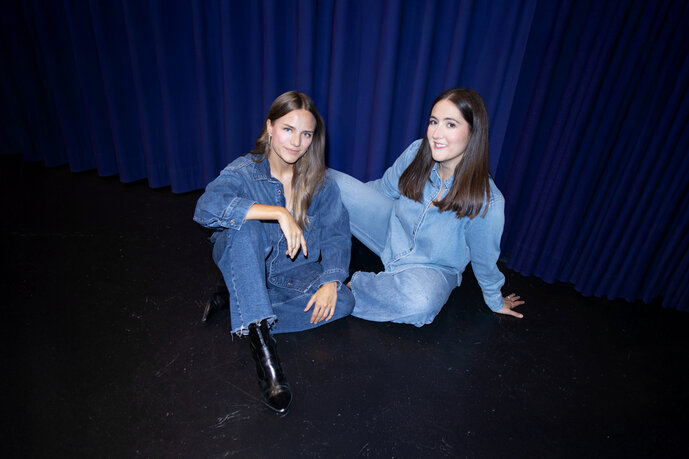
Christine Fischer (l.) und Amelie Poxleitner (r.) von the other archive
In conversation with the other archive, aka Amelie Poxleitner and Christine Fischer.
Hello, the other archive! You’re HfG alumni—why don’t you introduce yourselves briefly:
Who are you, and where can we find you right now?
We’re Amelie and Christine, and we work together as the other archive in our office at the Alter Schlachthof in Karlsruhe.
What did you study at the HfG, and what do you do for a living now?
We studied Communication and Product Design at the HfG, each with different specializations. The interdisciplinary nature of the program at the HfG encourages working beyond clear disciplinary boundaries and, as a result, fosters the ability to develop and guide creative processes holistically. Today, this is the central component of our work as creative directors. Ultimately, we see ourselves less as what we studied and more as creative strategists.
What motivated you to pursue an artistic/practical degree at the beginning of your studies?
We were both already working artistically before starting our studies and wanted to deepen our respective interests through our degree programs.
Do you remember why you specifically wanted to attend the HfG Karlsruhe, or why you applied to the HfG (among other schools)?
We were particularly fascinated by the HfG’s approach to the program. The option to pursue a diploma program is very valuable in the context of design. For us, however, the degree itself was less important than what comes out of it. An open, interdisciplinary program that allows for a lot of freedom. Students move between departments and carry out projects together. Working across semesters also fosters an exchange that is hard to teach.
When did the idea to collaborate after graduation come about?
While we were both reorienting our careers at the same time, an unexpected first inquiry came in even before we officially founded the company. We took the chance to simply test the waters, and that eventually led to our joint venture.
And what exactly do you do as the other archive?
We develop strategic brand identities for value-driven brands and design concepts and content that make them visible in the digital space. In doing so, we work across creative direction, branding, and social media.
What’s the story behind your name—the other archive?
The other archive represents our two inner archives and the sum of our collected impressions and references. Through our collaboration, this forms a shared, living archive that doesn’t preserve but rather transforms and enables new creative approaches.
Real Talk: How difficult is it to build your own business?
In our industry, getting started usually involves little financial risk, since the initial investment is primarily in time. The bigger challenge lies in building trust, developing your own client base, and becoming visible to new clients. This phase requires, above all, patience and perseverance.
What is the biggest difference between studying design and running design as a business?
The biggest difference is that as a student, you can freely pursue your own interests. The HfG Karlsruhe provides a special framework for this. The beauty of it is that you can usually design without compromise and, in the end, you have to be true to yourself above all else. And honestly, that’s sometimes harder than pitching an idea to clients.
What made Karlsruhe an attractive location for you?
Karlsruhe stands out for its geographical location and large catchment area. This means you’re not tied to a single city. At the same time, the city offers valuable support for the creative industries through initiatives like Perfekt Futur at the Alter Schlachthof, which is particularly valuable for young creative companies.
How do you decide which projects to accept or decline?
So far, we haven’t faced any requests that we couldn’t morally support. Especially in the beginning, we really appreciated working on a wide variety of projects, as this diversity keeps the work dynamic. Over time, our own profile becomes more defined, which also clarifies the scope of our services and expands our wealth of experience.
Anyone who knows you has probably experienced one of your food installations: What
fascinates you about these edible installations?
For us, this form of creative work is particularly exciting because every food installation starts with a specific theme that we then translate. This transformation is a major part of its appeal. At the same time, the direct interaction with the audience creates a sense of resonance that is rare in the traditional design context—and which we find very enriching.
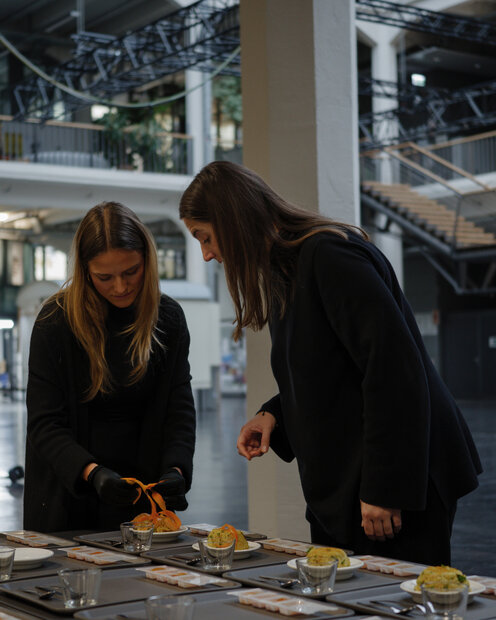
Food Styling Installation mit Christine Fischer (l.) und Amelie Poxleitner (r.)
Your Perspective as Female Founders: Do you see advantages or particular challenges as a female-founded studio?
All-female founding teams are still rare, which can certainly be an advantage in diversity-conscious contexts. At the same time, it can be challenging to establish a foothold as a female-led company.
How important is visibility and networking with other women in the industry to you?
Networking with women is very important to us. Our network includes many talented women whom we enjoy collaborating with and whom we specifically involve in projects. At the same time, we also benefit from male network partners who actively promote diversity and open doors for us. We would like to share these experiences.
Do you have role models or female designers who inspire you or have inspired you?
No single person stands out for us, but we like to draw inspiration from designers and art directors who deconstruct established standards and think unconventionally without creating designs that are exclusive.
What advice would you give to young female designers who want to start their own studio?
Back then, we talked to people in our HfG network who had already taken the leap into self-employment. That allowed us to learn from their experiences, and we’d give young designers the same advice. It helped us avoid some mistakes. Your network is a valuable resource, so use it!
What would you have liked to know before you started your business?
At the beginning, we weren’t fully aware of how crucial it is to start a business with someone you really get along with. We knew we could work well together, but over time it became clear to us how valuable it is to share the same values and work ethic. You grow incredibly close, almost like an extended family. We’re both very happy that we’re a team, and our tip to all founders is: Think carefully about who you want to take this step with.
Soft and/or hard skills: What did you take away from your studies at the HfG that particularly helps you today in your professional life—and perhaps even in your personal life?
“If a task feels familiar, it’s probably already too small.” A close friend once shared this with us, and it describes the HfG very aptly. Here, you’re constantly learning to step outside your comfort zone and try new things. This mindset helps us today, both in our professional lives and in our personal lives.
How did the HfG shape or teach you in terms of your approach to design?
At the HfG, we learned to fundamentally question the status quo, think outside the box, and always approach design projects with thorough research. This allows concepts to emerge that are unconventional and innovative.
What do you miss most about your time at the HfG?
The HfG is an exceptionally privileged place to carry out interdisciplinary creative projects. It’s incredibly valuable to be able to exchange ideas with experts from all fields while also having free access to professional equipment.
Thank you for the interview!
More info on the other archive can be found here: the other archive website: https://theothersocials.de/ the other archive socials: https://www.instagram.com/_theotherarchive/
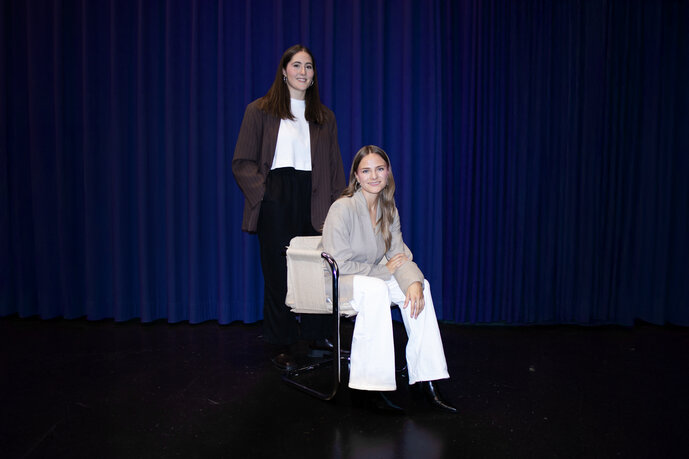
Amelie Poxleitner und Christine Fischer von the other archive

