

Portrait of Enrique Rivera Gallardo, Photo: Benjamin Matte
As part of the joint lecture series “thinking inside out” organized by ZKM and HfG, we invite international guests from the fields of philosophy, literature, and art to engage in an open exchange with university faculty and staff, ZKM employees, and the general public in Karlsruhe. The talk will be held in English.
On October 1, 2026, Enrique Rivera Gallardo will be our guest speaker and will discuss “Enchanted Objects.”
About:
A Glimpse into the Genealogy of Chilean Scientific Culture
In the early 1930s, Chilean advocates of functional syndicalism imagined a state in which trade unions and professional bodies would replace political parties as the basis of representation, taking the decentralized functioning of neurons as a model for the organization of society. In 1960 the scientists Carlos Martinoya and Nahum Joel exhibited the Chromatic Abstractoscope in Santiago, an experience they recounted in 1968 in the art and science journal Leonardo, and in 1972, a year after the nationalization of copper, Stafford Beer and a design team led by Gui Bonsiepe built the operations room of Project Cybersyn, through which Salvador Allende's government intended to follow the country's industrial production almost in real time, three chapters in which scientific imagination took root in the political and cultural life of a tectonic country.
This lecture reads these devices as enchanted objects and proposes that, taken together, they show how science has served in Chile as a scaffolding of the nation, shaping its institutions, its economy and its images of itself, a structure whose public understanding and integration into cultural life has become urgent now that the country's minerals feed the global infrastructure of data. Raúl Ruiz belongs to this lineage through Poetics of Cinema (1995), where he described a shamanic cinema in which objects and images acquire a life of their own, and through films that can be read today as a symbolic decoding of the hypnotic economy of attention later built by social networks and artificial intelligence.
In the present, lithium, copper and the rare earths that state-funded Chilean research seeks to recover from mining waste sustain the batteries and servers of data science, while Chilean artists and architects turn these materials against the supposed immateriality of the cloud through media art installations and sculptural volumes of coal, resin, marble and lithium that examine the minerals and water consumed by data centers and their impact on nearby communities, a situation that now places the ethics of media art production, and its own dependence on those resources, at the center of the debate.
About Enrique Rivera Gallardo
Enrique Rivera Gallardo is a researcher and filmmaker trained at the Escuela de Cine de Chile, the Universidad de Chile and the Universidad Mayor, whose research and artistic practice centre on expanded cinema. In the early 2000s he directed Galería Persona, between 2005 and 2007 he held a residency at ZKM in Karlsruhe, and from 2012 to 2022 he was director of the Chilean Media Arts Biennial (Bienal de Artes Mediales de Chile). He is currently executive director of the Centro Interactivo de los Conocimientos (MIM) in Santiago, where he has strengthened the relationship between art, science and the environment through initiatives such as the institution's media library and documentation centre, the Adriana Hoffmann Forest, named after the Chilean botanist and environmentalist, the Museum of Audiovisual Arts and the Interactive Museum of Astronomy.
![Estado Sindicalista Funcional (Functional Syndicalist State). Diagram of the national organisation proposed by Chilean functional syndicalism, which is described in its caption as socialist, democratic, unitary, decentralised, "abureaucratic", without classes or parties, and "organic". Councils are arranged as concentric cells at the communal, zonal and national levels, with the Supreme Chief at the core. [Grupo Nervio, Sindicalismo funcional, 1936]](/aktuelles/diskursreihe-thinking-inside-out-mit-enrique-rivera-gallardo-am-11026/image@689x620.png)
Estado Sindicalista Funcional (Functional Syndicalist State). Diagram of the national organisation proposed by Chilean functional syndicalism, which is described in its caption as socialist, democratic, unitary, decentralised, "abureaucratic", without classes or parties, and "organic". Councils are arranged as concentric cells at the communal, zonal and national levels, with the Supreme Chief at the core. [Grupo Nervio, Sindicalismo funcional, 1936]
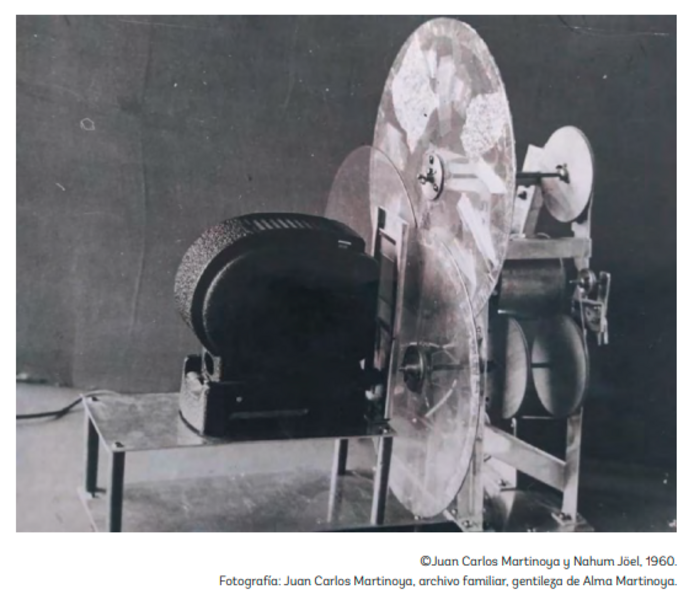
Juan Carlos Martinoya and Nahum Joël, Abstractoscopio Cromático, 1960. Photograph: Juan Carlos Martinoya, family archive, courtesy of Alma Martinoya. (© Juan Carlos Martinoya & Nahum Joël)
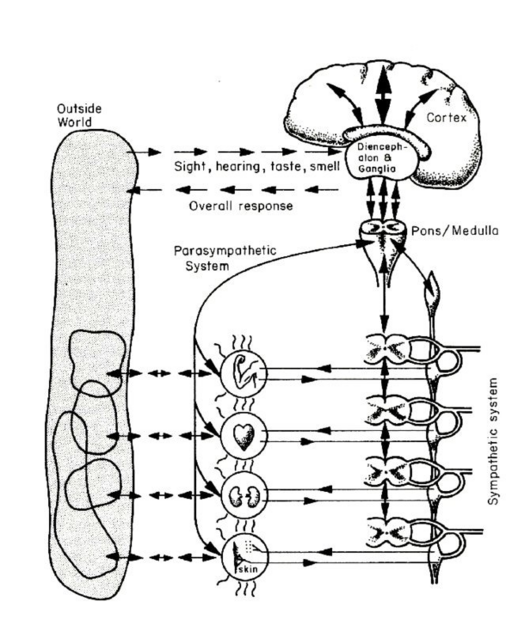
Stafford Beer, diagram of the human nervous system as a model of regulation. The figure shows the cortex, the diencephalon and ganglia, the pons and medulla, and the sympathetic and parasympathetic systems in exchange with the "outside world". It is the physiological basis of the Viable System Model that later structured Project Cybersyn. From Brain of the firm, Stafford Beer, Allen Lane the Penguin Press, 1972.

Mineral specimen: Bastnäsita-(Ce) por Matteo Chinellato / Wikimedia Commons

