
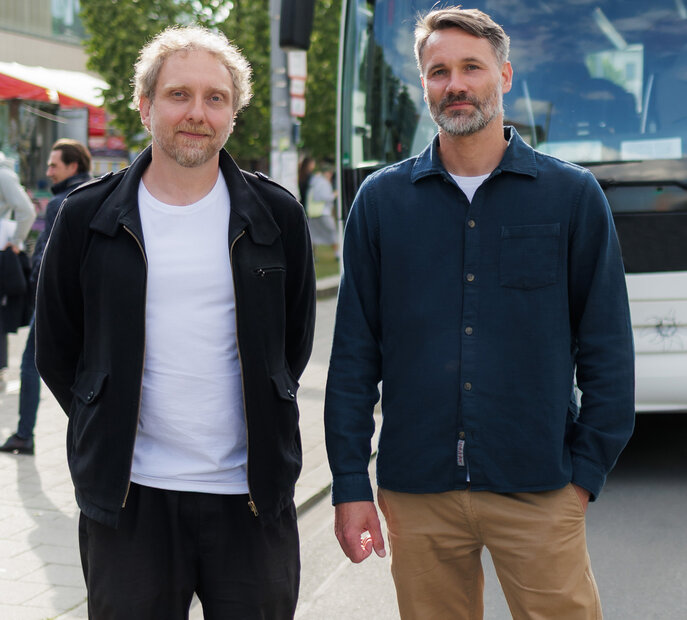
Portrait: Johannes Marmon (l.) und Johannes Müller (r.), Photo: Marian Wilhelm
Hi Johannes and Johannes! You’re both HfG alumni—please feel free to introduce yourselves briefly: Who are you, and where can people find you these days? What did you study at the HfG, and what do you do for a living now?
We’re Johannes Marmon and Johannes Müller; we both studied product design at the HfG from 2000 to 2005/2006. We’re still based in Karlsruhe with our company Nyta, where we design, develop, produce, and sell lighting fixtures.
What motivated you to pursue an artistic/practical degree program at the start of your studies?
Of course, a personal interest in design. But we didn’t view the program primarily as artistic or practical; rather, we valued the breadth of the general curriculum, including the research-oriented and theoretical aspects.
Do you remember why you wanted to go to the HfG Karlsruhe of all places, or why you applied (among other schools) to the HfG?
To be honest, neither of us really realized at the time just how free the program at the HfG would be. Still, we liked the application process—especially the entrance exam—much better than at other universities.
We really enjoyed the freedom of the program and still consider it a key strength of studying at the HfG: that you aren’t tied to a specific career path or goal, and ideally can study not only within your department but also in an interdisciplinary way beyond it—on your own initiative, of course. We still feel a strong connection to the HfG and hope that this distinctive freedom can remain intact—the prevailing practices and exchanges with other design schools, which offer bachelor’s and master’s programs, among other things, and with which there is an exchange of students and faculty, threaten to undermine and homogenize this freedom—simply out of habit. We hope that the special freedom at the HfG will continue to be nurtured and developed in the future. Of course, it’s important that students also know what they’re getting into—after all, the program does pose its own unique challenges.
You’re known here in Karlsruhe as the (co-)founders of Nyta Lighting: When did the idea to start a design studio together come about?
We almost had to decide against it rather than for it—we’d been working together continuously since our college days and just kept it going. At first, we also worked as traditional designers. We founded Nyta a few years later. With Nyta, we manufacture and market lighting fixtures, so we’ve gone well beyond just design.
And what originally led you to focus specifically on light and lighting fixtures?
As a product design firm, we didn’t initially focus on this, but we had geared Nyta toward it. This was related to a few specific projects, our network at the time—which included partners in the lighting industry—and a strong interest in the subject matter.
What distinguishes the design of lighting fixtures from design of other products?
Lighting always requires a focus on light as a product—and thus on its effects and function. This also entails additional technical requirements. But on the one hand, this is no different for products that deal with liquids, sound, or temperature; on the other hand, we don’t see the underlying principles of design as any different from those of other products.
Real Talk: How long did it take you to build up your “business” together?
The start-up phase certainly took 1–2 years. But essentially, we’re still developing Nyta today and, with our small team, adapting to internal and external circumstances. Recently, in addition to our line of standard lighting fixtures, we’ve increasingly been developing and producing custom lighting fixtures for projects—that is, bespoke fixtures and lighting installations for larger projects.
What made Karlsruhe an attractive location for you?
We like the city, but sometimes it feels too small to us. The location is good, but that doesn’t matter much to us—we could just as easily be somewhere else. Our customers and suppliers for our lighting fixtures are based in other places anyway.
What’s the story behind the name—what does “Nyta” mean?
The name has no specific meaning; back then, we were looking for a short, melodious name that wasn’t already taken, would work internationally, and could be trademarked. However, there is the Swedish word “nytta,” which means “benefit” or “useful”—we like that, though we didn’t know it beforehand.
On average, how long does it take for a new light fixture to come to life?
Depending on the fixture, it takes us 2–3 years—from the initial idea through development, prototype production, market launch, and mass production.
Where do you get your inspiration for designing the lights? What drives you?
We don’t go out of our way to find it—it’s always with us. The deeper you delve into topics and ways of thinking, the more you learn about existing solutions and problems, and the broader your view of possibilities becomes, the more naturally ideas come to you in everyday life. This immersion in a subject seems very valuable to us as designers—at least for us.
What materials do you use?
Our lighting fixtures to date feature a lot of metal, glass, and some plastic elements. But that’s not a deliberate choice—it’s just how it’s turned out so far. Currently, we’re exploring approaches using paper as well as ceramics, for example. And when it comes to lighting, there’s no getting around light itself as a material.
Do you also manufacture in Karlsruhe?
Yes, but only prototypes or samples, and some assembly work. Our manufacturing facilities are scattered across Europe, particularly in northern Italy and Germany.
Does “form follows function” really still apply in (lighting) design—or has the relationship perhaps even been reversed in the meantime?
That’s something every designer can decide for themselves, time and again. We don’t take a rigid stance on this either.
What role does sustainability play in lighting design today, or rather, what role does it play for you at Nyta—and where might the biggest challenges lie?
One of the major challenges lies in understanding and interpreting the term. The focus tends to be on materials, manufacturing, transportation, packaging, etc.—and solutions in these areas, whether good or bad, are then used as justification. But the most sustainable light fixture is the one that isn’t manufactured in the first place. Long-term use—not just usability—and reuse are too often overlooked.
Which disciplines do you collaborate most closely with when designing a light fixture (e.g., engineering, lighting design, architecture)?
Design and development almost always come from our team. Especially with custom light fixtures, the specific projects set the framework; in these cases, architects, interior designers, and lighting designers are key partners.
What do you enjoy most about being a (product) designer?
The initial brainstorming and early design phases.
Is there anything about this profession that you find particularly challenging and would rather do without?
In our case, it’s the challenge of maintaining consistent quality in our lighting fixtures. This is an ongoing effort we make together with our suppliers.
In a way, you’re real local heroes, since your lights are hanging, for example, at your immediate neighbor on Sophienstraße, iaro coffee: Where else can people see Nyta lights in Karlsruhe—and around the world—(if you’re allowed to share that information)?
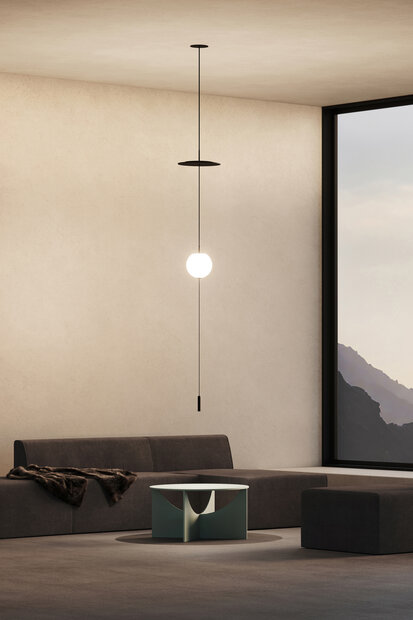
In Karlsruhe, our lights are installed in quite a few places—besides iaro, in other cafes, restaurants, offices, and at private residences. In addition to Europe, we sell our lights to Japan, Australia, Korea, Mexico, and the U.S.—where we’ve also had some exciting projects. Recent highlights include, for example, the Grieder / Bongénie department store in Zurich and Coca-Cola’s Europacific headquarters in Berlin. But iaro is, of course, particularly close to our hearts. We update our lighting there from time to time and are delighted that they’re beautifully showcased alongside great coffee—even during our own coffee breaks.
Soft and/or hard skills: What did you take away from your studies at the HfG that particularly helps you today in your professional life—and perhaps even in your personal life?
We’ve really internalized the project-based approach to learning. Essentially, we view everything we do as a collection of projects. And the perspective-shifting, questioning, creative, and open-minded attitude we developed during our studies—asking, “How else could this be?”—continues to shape us far beyond the realm of product design.
How did the HfG shape or teach you in terms of your approach to design?
In terms of content, it taught us to fundamentally question habits and given circumstances, as well as to approach existing structures and necessities with a fair amount of freedom. In terms of implementation, it certainly emphasized doing things yourself and taking the initiative. Here, we also see a crucial value in the structure of the program as we experienced it and as we believe it still largely remains today. We view the focus on supporting students in their own studies and projects—ideally without any prescriptive guidelines or directives, but at most with suggestions or motivation—as a remarkable distinctive feature and a core value of studying at the HfG. The opportunities we were offered at the HfG would hardly have been available elsewhere in the same way, even if we had to learn how to navigate that freedom. For example, precisely in doing things on our own and taking the initiative ourselves.
In your opinion, what skills should design students develop if they want to work in lighting or product design later on?
Develop a broad perspective on different fields, get to know a wide variety of areas, understand how they’re connected, and delve into many topics—this not only fosters an understanding of these fields, but also gives you the opportunity to discover and contextualize your own interests and abilities.
Once you’ve figured out what brings you the most joy, it’s worth pursuing that path. For one thing, you’ll enjoy it the most, and for another, you’ll be better at it with that passion than without it.
THANK YOU for the interview!
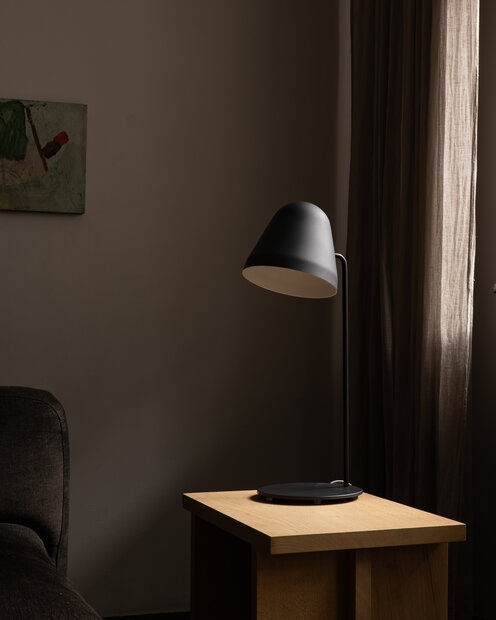
Tilt Table, Photo: Tina Schmid

